What Google Actually Wants From Your Business Website
Strip away the SEO folklore and Google's requirements are short, stable, and mostly within your control. Here is what search engines actually reward in a business website — and what owners waste money chasing.
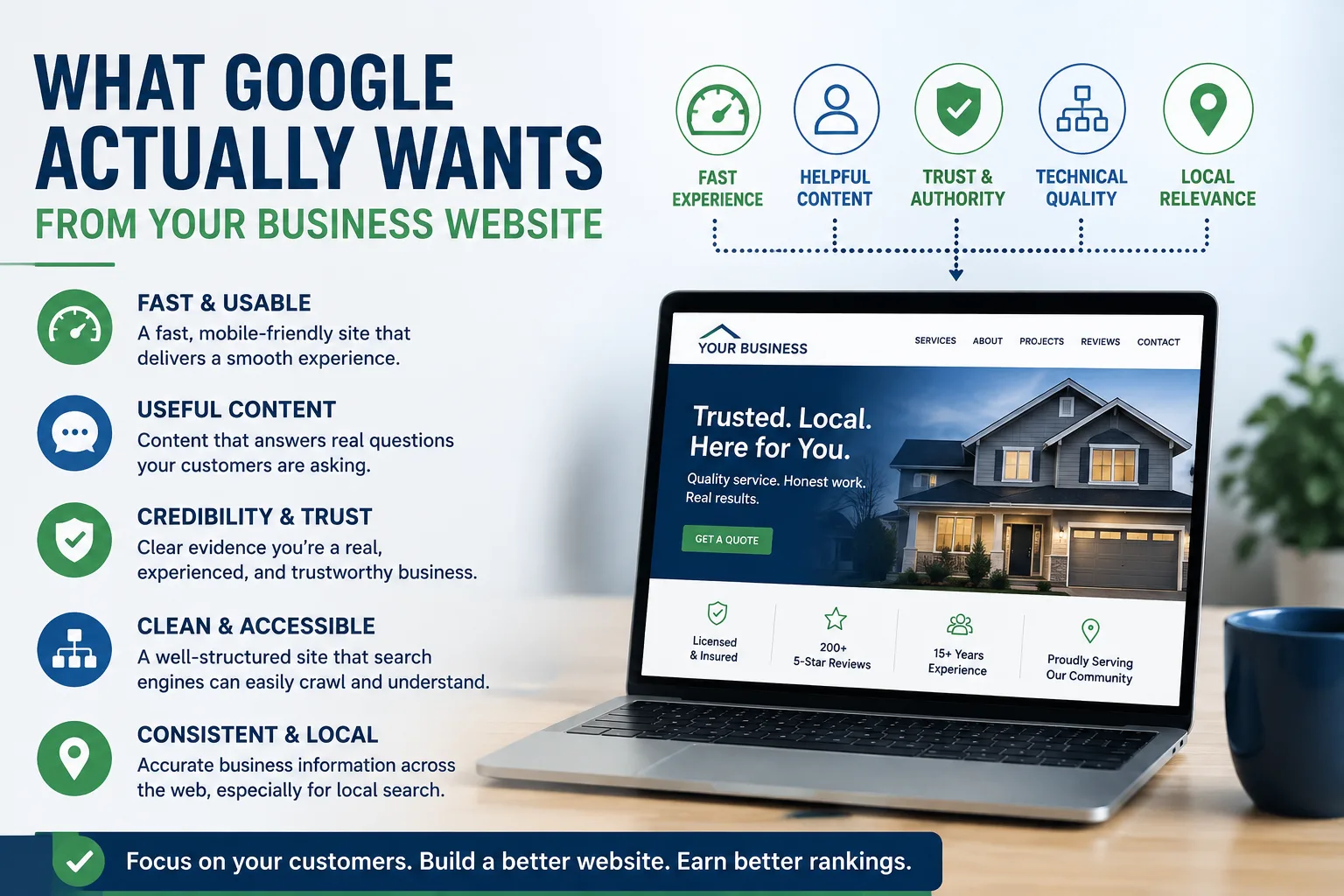
Ask ten people what Google wants and you will get ten answers, most of them wrong and several of them expensive. Keyword density. Blogging twice a week. Backlink packages from a vendor who found you through a cold email. Meta keywords, which Google stopped using before some of the people selling them were born.
The actual answer is duller and far more useful. Google is a business with one product problem: someone types a question, and Google has to hand back a page that answers it without wasting their time. Every ranking system it has ever shipped is an attempt to identify pages that do that. So the question is not "how do I please the algorithm." It is "is my page genuinely the best answer to a question my customers are asking, and can Google tell?"
Both halves matter. Plenty of businesses are the best answer and remain invisible because nothing on the site makes that legible to a machine. Here is what actually goes into being both.
1. A page that loads fast enough to be usable
Google measures real-world loading experience through Core Web Vitals — three metrics with intimidating names and simple meanings. Largest Contentful Paint asks how long until the main content appears. Interaction to Next Paint asks whether the page responds when someone taps something. Cumulative Layout Shift asks whether the page holds still or jumps around while it loads, moving the button out from under a thumb.
These are part of Google's page experience signals. They are not the most important ranking factor — a fast page about the wrong thing still loses to a slow page about the right thing — but they are a real tiebreaker, and in local and commercial searches most of the competing pages are about the right thing. When ten roofers all have a roofing page, the tiebreakers decide.
The bigger effect is indirect and arrives before Google is even involved. People abandon slow pages. That abandonment costs you the lead regardless of where you ranked, which is why we treat speed as a revenue question rather than a technical one — the full argument is in Is a Fast Website Worth It?.
Worth knowing: Google evaluates the mobile version of your site, not the desktop one. Mobile-first indexing has been the default for years. If your site is respectable on a laptop and a mess on a phone, the mess is the version that counts. You can check where you stand in about a minute with our free speed check.
2. Content that answers the question actually being asked
Google's published guidance keeps circling one idea: create content for people, not for search engines. That sounds like a platitude until you look at what it rules out. It rules out pages written to hit a keyword count. It rules out twelve near-identical service pages that differ only by a city name swapped in. It rules out the blog post that takes nine paragraphs to say something that needed two.
What it rewards is specificity. A page that says "we provide quality plumbing solutions for residential and commercial clients" answers no question anyone typed. A page that says what a water heater replacement costs in Phoenix, how long it takes, whether you pull the permit, and what happens if it fails on a Sunday — that page answers several, and it answers them for a person who is minutes away from calling somebody.
The practical test: read your page and ask what question it is the best answer to. If you cannot name one, Google cannot either. If you can name six, you probably need six pages.
This is also where most business sites are structurally short. One "Services" page listing eight services competes for nothing, because it is not the best answer to any of the eight questions. Eight real pages, each thorough, each answering one thing completely, compete for eight. That is the entire logic behind the service-area matrix we built for Ancla Plumbing — seven service pages against fourteen city pages, so the long-tail searches that actually convert each have a page written for them.
3. Evidence that you are who you claim to be
Google's quality rater guidelines lean on a clumsy acronym, E-E-A-T: experience, expertise, authoritativeness, trustworthiness. Raters are not the algorithm, but the guidelines describe what the algorithm is built to approximate, which makes them a decent reading of Google's intent.
Translated for a normal business, it asks: is there any evidence a real, competent operation is behind this website? That evidence is unglamorous and mostly consists of things you already have and failed to publish. Licenses and license numbers. Certifications, with the issuing body named. Years in business. Named people with actual titles, not a stock photo captioned "our team." A physical address. Real project examples. Reviews you did not write.
Trades and regulated fields have an advantage here and usually squander it. Rite-Way Roofing holds more than fourteen manufacturer certifications from GAF, Owens Corning and others; those had never been surfaced anywhere a search engine could see them. Putting the certification wall on the site was not decoration — it was publishing evidence that a machine could read and a facilities manager could verify.
The same logic drives the opposite decision. When we rebuilt QTC, an FAA Part 145 repair station, every claim that could not be substantiated got removed rather than softened. Regulated buyers check. So does Google, at scale.
4. A site it can actually read
Before Google can judge your page it has to fetch it, render it, and understand it. Most of what breaks here is invisible to the business owner because the site looks fine in a browser.
The fundamentals: every page you want ranked has a unique title and description, one clear H1, and headings that describe an actual hierarchy rather than being chosen for their font size. Content lives in the HTML, not painted in by JavaScript after the fact. Internal links connect related pages so crawlers can find everything from anywhere. The sitemap lists what exists; robots.txt does not accidentally block half of it. Each page declares one canonical URL, so the same content at four addresses does not compete with itself.
Then there is structured data — a block of machine-readable code that states plainly what a page is: a business, its address and hours, a service, an FAQ, a product, a set of breadcrumbs. It is not a ranking boost, and anyone selling it as one is guessing. What it does is remove ambiguity and make you eligible for the richer search results — star ratings, FAQ dropdowns, business panels — that take up more of the screen than a plain blue link. We wrote a jargon-free explanation in Structured Data, Explained Without the Jargon.
One rule that gets violated constantly: the structured data must match what a visitor actually sees. FAQ schema listing questions that appear nowhere on the page is the fastest way to get the markup ignored. On Gun Boss we drove the visible FAQ accordion and the FAQ schema from the same source, so the two cannot drift apart.
5. Signals that anchor you to a place
If customers find you by searching a service plus a city, you are competing in local search, which runs on partly different machinery — the map results, driven heavily by proximity, prominence, and consistency.
Consistency is the piece businesses control and neglect. Your name, address, and phone number must be identical everywhere they appear: the website, Google Business Profile, directories, the old listing from the office you left in 2019. Google is reconciling these into a confident picture of a single real business. Contradictions make it less confident, and less confident means lower.
Beyond that, local ranking wants a real Google Business Profile that is maintained rather than claimed and abandoned, reviews arriving steadily, and pages on your site that correspond to the places you actually serve. We go through this in detail in What It Actually Takes to Rank in Your Own City.
What Google does not want, despite what you have been told
Volume for its own sake. Publishing weekly because a vendor said frequency matters produces a library of thin pages that dilute the good ones. Ten pages that deserve to rank beat sixty that do not.
Purchased links. Google has spent two decades getting better at detecting paid link networks, and the downside is asymmetric: a modest, temporary lift against a penalty that is genuinely hard to unwind.
Keyword stuffing and its modern cousin, the page written to accommodate a phrase rather than a reader. "Emergency plumber Phoenix AZ 24/7 emergency plumber near me" reads exactly like what it is.
Chasing a Lighthouse number for its own sake. A perfect 100 on a page nobody wants to read is a perfect score on the wrong test. Speed is a multiplier on content that already deserves to rank — which is why we say the architecture is the floor, not the ceiling.
And meta keywords. Google confirmed it ignores them in 2009. They are still in the code of a startling number of business sites.
Where this leaves you
There is no trick, which is either discouraging or liberating depending on the week. Google wants a fast page that genuinely answers a question, published by a business that visibly exists, on a site clean enough to read and consistent enough to trust. Everything else is commentary.
The reason so few small-business sites clear that bar is not that it is hard to understand. It is that the platform most of them run on works against three of the five requirements at once — accumulating weight until the site is slow, drifting out of date until the evidence is stale, and burying content under code that crawlers have to fight through. We wrote about that architecture problem in Static vs. WordPress: The Real Total Cost.
If you want a starting point rather than a project: run your own site through a speed check, then open your three most important pages and ask, for each one, what question it is the best answer to. Those two exercises will tell you more about your search visibility than any audit you can buy.