What It Actually Takes to Rank in Your Own City
Local search runs on different machinery than the rest of Google — proximity, prominence, and consistency. Here is what moves those levers for a business that sells to the people around it.
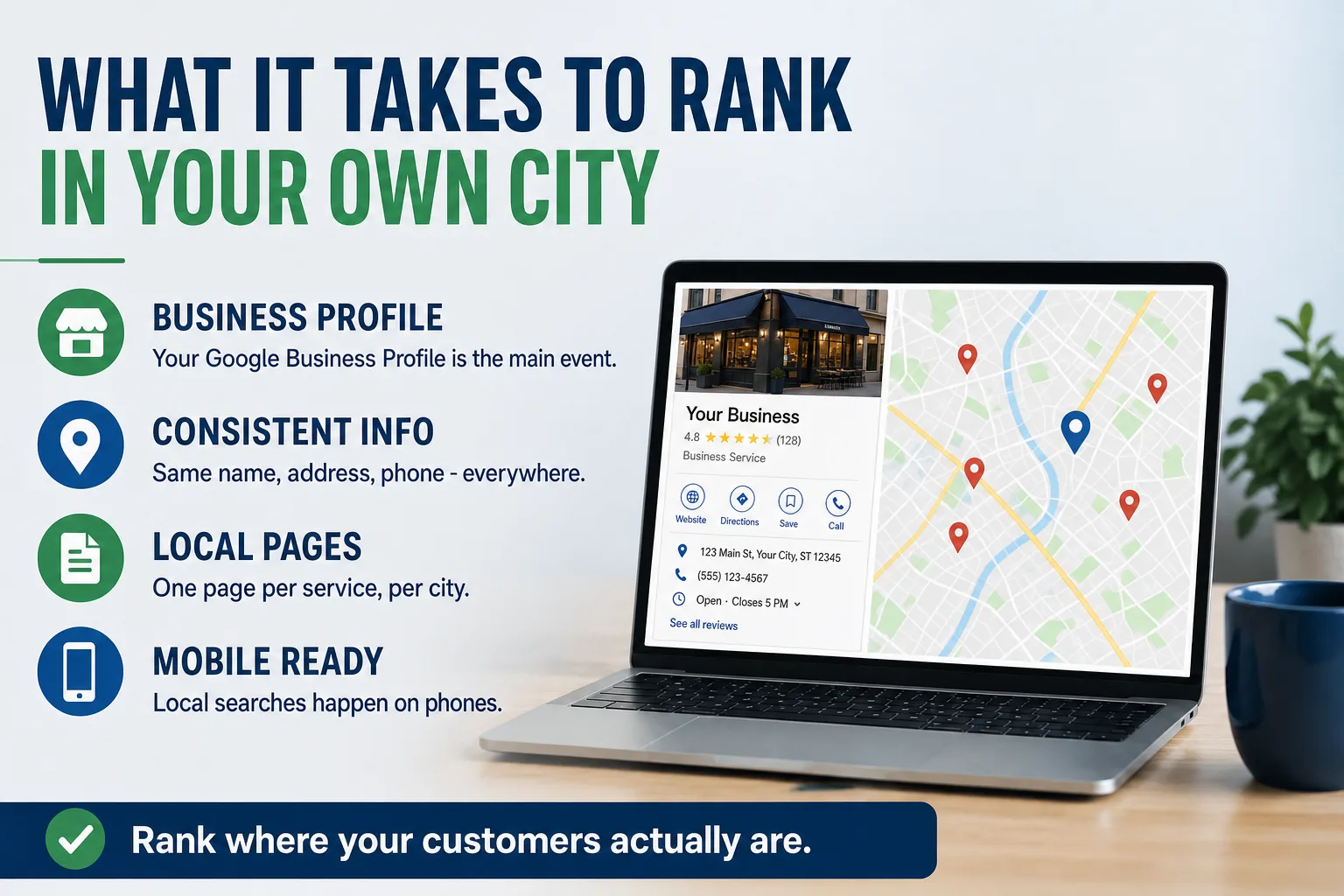
If your customers find you by typing a service and a place — "emergency plumber Mesa," "commercial roofer near me," "gun store Bullhead City" — you are competing in local search, and local search does not work the way the rest of Google does.
The map results at the top of those searches are ranked largely on three things Google states openly: relevance, distance, and prominence. You cannot move a building, so distance is mostly fixed. That leaves relevance and prominence, both of which are more controllable than most business owners realize and neither of which is fixed by making the website prettier.
Your Google Business Profile is the main event
For map results, the profile often matters more than the website. It needs to be claimed, complete, and maintained rather than filled in once in 2019 and abandoned.
Complete means the primary category chosen precisely — "roofing contractor" and "commercial roofing contractor" surface for different searches — plus accurate hours including holidays, service areas, photos that are actually of your business, and the services list filled out. Maintained means reviews arriving steadily rather than in one suspicious burst, and getting responses, including the unhappy ones. A steady trickle of reviews over years reads as a real operating business. Forty reviews in one week reads as something else.
The website's job is to corroborate all of it. Which brings us to the least glamorous and most consequential item on this list.
Name, address, phone — identical everywhere
Google is assembling a confident picture of one real business from fragments scattered across the web: your site, your profile, directories, chambers of commerce, supplier listings, the review sites you have never logged into. Every place your name, address, and phone number appear is a vote for what those values are.
Contradictions cost you. "Suite 200" on the site and "Ste. 200" on the profile is survivable. A tracking number on one listing and your real line on another, an old address from the office you left three years ago still live on four directories, a business name that appears as "Rite-Way Roof Corp." here and "Riteway Roofing Inc" there — these accumulate into genuine uncertainty, and uncertainty ranks lower than confidence.
This is tedious and unglamorous work that no one enjoys, and it is frequently the single highest-return thing a local business can do. Pick the canonical version of your name, address, and phone number, write it down, and make every surface match it exactly.
One page per thing you sell, per place you sell it
Here is where most local sites are structurally too small to compete. A single "Services" page listing eight services, and a homepage mentioning a county, is not the best answer to any specific search — so it ranks for none of them.
The alternative is a matrix. For Ancla Plumbing we built seven service pages — drain cleaning, water heaters, water lines, leak detection, fixtures, filtration, emergency service — against fourteen city pages covering Phoenix, Mesa, Gilbert, Chandler, Scottsdale and the rest of the East Valley. Each page exists because someone searches for that specific thing in that specific place, and now there is a page that is genuinely the best answer to it.
The failure mode to avoid is doorway pages: fourteen identical pages with the city name find-and-replaced. Google has been penalizing that for over a decade and it is trivially detectable. Each page has to earn its existence with something real — the neighborhoods covered, response times to that area, permit specifics for that municipality, jobs actually done there. If you cannot write three genuinely different paragraphs about serving that city, that page should not exist yet.
This is also the logic behind our industry pages: a manufacturer and a roofing contractor are searching for different things and deserve pages that were written for them rather than a shared page that was written for neither.
Tell search engines where you are, in a language they parse
Structured data is how you state your location and hours as machine-readable fact rather than leaving it to be inferred from a footer. LocalBusiness schema — with your name, address, phone, geo-coordinates, per-day opening hours, and the areas you serve — turns your address from decoration into data. We cover what this actually is in Structured Data, Explained Without the Jargon.
On Gun Boss, a firearms shop in Bullhead City competing across an eight-city Tri-State corridor, that layer is the entire local strategy: a complete GunStore schema graph with full NAP, geo-coordinates, a Google-backed map reference, per-day hours generated from one source of truth, and a served-area list covering all eight cities the shop actually draws from. The point is not the markup for its own sake. It is that a small independent shop can be described to Google as precisely as a chain with a corporate SEO department.
One rule: the structured data has to derive from the same source as what visitors see. Hours in the schema that disagree with the hours on the page is a self-inflicted wound.
The mobile reality check
Local search is overwhelmingly mobile and frequently urgent. Someone standing in a flooded laundry room is not evaluating your brand story.
Which means the practical local ranking factors include some that look like usability rather than SEO: does the page load in under two seconds on cellular, is the phone number tappable, is "Get Directions" one tap from anywhere. On Gun Boss the mobile directions bar hands straight off to Apple Maps or Google Maps with a single tap, because the goal of that entire website is foot traffic through a door.
Google measures the mobile version of your site, and so does your customer. If the two disagree about which is the real version, your customer wins and Google agrees with them.
A reasonable order of operations
Claim and complete the Google Business Profile. Fix name, address, and phone consistency everywhere it appears. Get the site loading fast on a phone — check with a speed test. Add LocalBusiness structured data driven from one source of truth. Build genuine pages for the services and places that matter, a few at a time, each one actually different. Ask satisfied customers for reviews, steadily, forever.
None of that is a growth hack and all of it compounds. Local ranking is mostly the accumulated result of being unambiguously findable, verifiable, and consistent over time — which is why it rewards businesses willing to do dull work reliably, and why it is one of the few places a small operator can beat a much larger competitor.