Is a Fast Website Worth It? The Business Case for Speed
Page speed gets sold as a technical virtue. It is actually a margin question — it decides how much of your traffic survives to become a lead. Here is how to price it for your own business, including when it is not worth it.
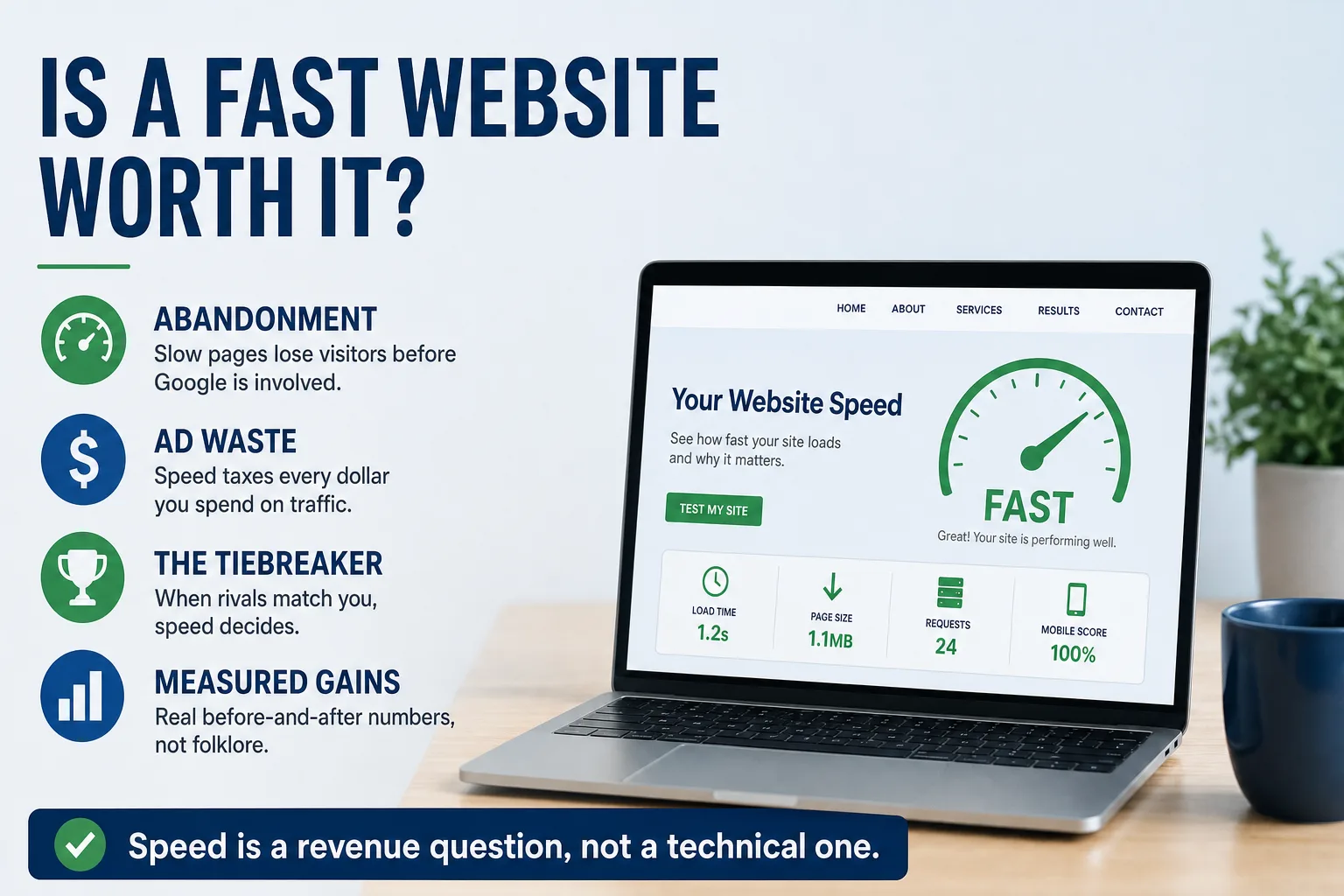
Every web vendor tells you your site should be faster. Almost none of them tell you what that is worth, which is the only part a business owner actually needs. A number like "three seconds" means nothing on its own. Three seconds of what, costing whom, how much?
So here is the case in the terms it belongs in — leads, cost per lead, and the fraction of your marketing budget that currently evaporates between the click and the page. Including, at the end, the honest version of when speed is not your problem and spending money on it would be a mistake.
The cost that lands before Google is involved
The first thing a slow site costs you is not rankings. It is people who already found you.
Somebody searches, sees your listing, taps it, and waits. On a phone, on cellular, standing in a parking lot. Every additional second of that wait sheds a portion of them, and they do not bounce with a note explaining why. They hit back and tap the next result, which is your competitor. Google's own research into mobile behavior has consistently found abandonment climbing sharply past the three-second mark — and the people most likely to leave are the ones in a hurry, which in most trades means the ones with an emergency and a credit card.
This loss is invisible in a way that makes it dangerous. It does not appear in your analytics as a lost lead, because there was no lead. It appears, if at all, as a bounce rate you have never looked at. The revenue simply never shows up, and nothing in your reporting connects its absence to your website.
Compare that to a lost quote, which everybody notices and discusses. The slow-site loss is larger for most businesses and gets discussed by nobody.
The tax on everything else you spend
Here is the part that reframes the whole conversation. Load time is a multiplier on every channel you already pay for.
You buy a Google Ads click. You pay the same whether the page renders in eight hundred milliseconds or seven seconds. If a meaningful share of those visitors leave before the page paints, you paid full price for traffic that never saw your offer. Same for the postcard with the URL, the truck wrap, the sponsored listing, the referral who typed your name into a phone.
That is why the speed question is not really a website question. It is a marketing efficiency question that happens to have a technical answer. Every dollar you spend driving people to a slow site is a dollar taxed at the door, and the rate is set by your architecture.
Run it yourself with your own numbers. Take your monthly visitors, your current lead conversion rate, and your average job value. Then ask what a ten or twenty percent improvement in the share of visitors who stick around is worth annually. For a contractor doing six-thousand-dollar jobs, recovering a handful of leads a month pays for a rebuild in a quarter and then keeps paying. For a business with a two-hundred-dollar average ticket and forty visitors a month, it does not. Both answers are legitimate; only one of them gets sold to you.
The ranking effect, stated accurately
Speed is a genuine ranking input through Core Web Vitals, and it is smaller than most vendors imply. Relevance dominates. A fast page about the wrong subject loses to a slow page about the right one, every time.
But notice what commercial search actually looks like. When somebody searches "commercial roofing contractor Riverside," the top ten results are all commercial roofing contractors in Riverside. Everyone is relevant. Relevance has stopped differentiating, and the tiebreakers — speed, mobile experience, structured data, trust signals — start deciding. That is the situation nearly every local business is in, which is why a secondary factor behaves like a primary one in practice. The broader picture is in What Google Actually Wants From Your Business Website.
What it looked like when we measured it
We rebuilt our own parent company's site — Neuron Computers, a managed IT provider serving manufacturers since 2001 — precisely because it was failing this test. The WordPress original averaged 6.8 seconds on mobile and scored 34 on PageSpeed Performance. Bounce rate had reached 71 percent. For a company selling infrastructure reliability, the website was an argument against the pitch.
After the rebuild on static architecture: PageSpeed 100, bounce rate roughly halved, and form submissions up 85 percent. The content was substantially the same content. What changed was how much of the traffic survived long enough to read it.
The same pattern held for David Plotkin, Ph.D. and Associates, a Los Angeles CBT practice whose 2017 WordPress theme scored 49 on mobile — for a practice whose prospective clients are often anxious people reaching for a phone at two in the morning. That rebuild finished at 100 across all four Lighthouse categories. When the visitor is in distress, every second of load time is a second in which they can reconsider calling anyone at all.
Neither of those is a marketing claim about a general law of the internet. They are two measurements, from two rebuilds, where the before-and-after was clean.
Why your site got slower when nobody touched it
Business owners often say some version of "it used to be fine and we haven't changed anything." Both halves are usually true, and that is the diagnosis rather than a contradiction.
Conventional sites decay on their own. The plugin count creeps up as each small feature request gets solved by installing something. Photos go up straight from a phone or a camera at full resolution, and a single page ends up heavier than an entire well-built website. Marketing adds a chat widget, a tracking pixel, a review carousel, a scheduling embed — each one loading third-party code from someone else's server at someone else's speed. The theme ages past its framework. Shared hosting fills with neighbors.
None of these is a decision anyone remembers making, which is exactly why the site can get twice as slow in two years with an untouched content calendar. It is not neglect in the moral sense. It is what the architecture does when left alone.
That is also why speed work done as a one-time optimization pass tends to unwind. If the underlying stack is one that accumulates weight, tuning it buys you eighteen months. The alternative is architecture that has nothing to accumulate: pages pre-rendered into plain HTML at build time and served from a CDN, with no database queries, no plugin chain, and no server work between the request and the response. A site built that way scores the same two years later because there is no mechanism by which it degrades.
When speed is not your problem
The honest counter-argument, which you will rarely hear from someone quoting a rebuild.
Speed is a multiplier, and a multiplier on zero is zero. If your site loads instantly and still generates nothing, the problem is upstream: nobody is finding you, or the people finding you are the wrong people, or the page never makes clear what you do and why anyone should call. Rebuilding a fast version of an unconvincing site produces an unconvincing site that loads quickly. We wrote the diagnostic for that in Why Your Website Isn't Generating Leads.
Speed also matters less when the buyer has already decided. If your traffic is overwhelmingly people who typed your company name because a friend referred them, they will wait four seconds. They came for you specifically. It is the searcher comparing three unfamiliar options who leaves, which is why speed correlates so strongly with how much of your business comes from discovery rather than reputation.
And a mediocre score is not automatically an emergency. There is a real difference between a site at 85 that could be tuned and a site at 30 that is structurally broken. The first is a maintenance item. The second is the architecture, and no amount of image compression fixes it — which is the distinction we lay out in Rebuild or Repair?.
How to decide in an afternoon
Run your site through a PageSpeed check and read the mobile score, not the desktop one — mobile is what Google indexes and what your customers are holding. Under 50 means architecture. Between 50 and 90 means tuning. Above 90, speed is not your bottleneck and you should spend the money elsewhere.
Then do the arithmetic above with your own traffic, conversion rate, and job value. If recovering a modest share of abandoning visitors covers the cost inside a year, the decision is already made and the only remaining question is who does the work — for which we wrote What to Ask Before You Hire Anyone to Build Your Website.
If it does not pencil out, do not do it. A slow site that is cheap and adequate for a business running on referrals is a defensible choice. What is not defensible is paying for traffic to arrive somewhere that loses a third of it, and never having done the arithmetic to know.