Static vs. WordPress: The Real Total Cost of a Business Website
The build quote is the smallest number in your website's life. A clear-eyed comparison of what WordPress and managed static architecture actually cost over three years.
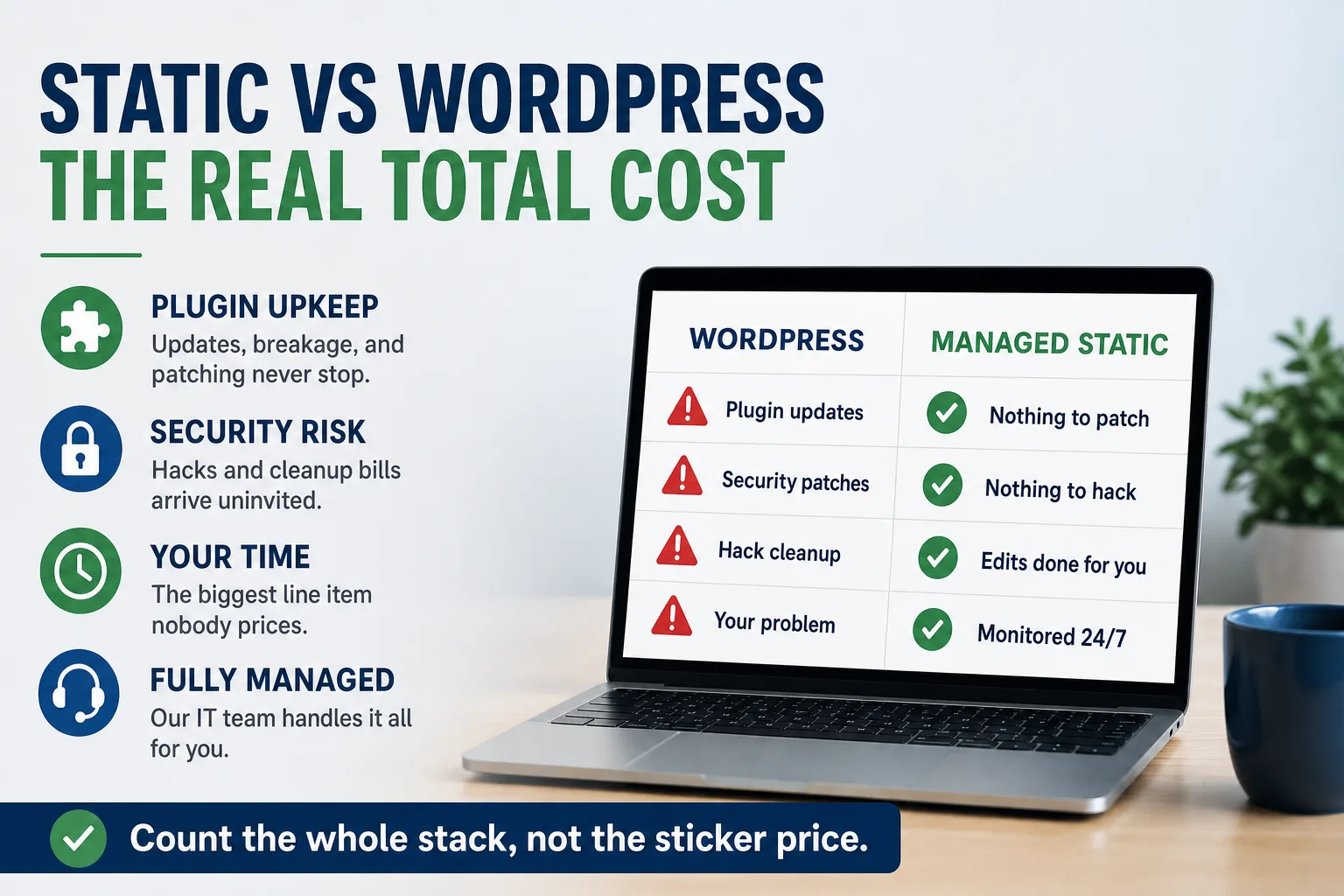
Website pricing conversations fixate on the build quote — and the build quote is the smallest number in the site's life. The real cost of a business website is the build plus everything it takes to keep it fast, secure, and current for years: hosting, maintenance, fixes, lost leads when it slows down, and the redesign when it finally collapses under its own weight.
Compare platforms on that lifetime number and the rankings change dramatically. Here is the honest math, without vendor spin in either direction.
The WordPress cost stack
A professionally built WordPress site for a small business commonly quotes anywhere from a few thousand dollars to five figures. Then the recurring layer begins: hosting (decent managed WordPress hosting runs $25–$100+ per month), premium theme and plugin licenses (often a few hundred dollars a year), and — the line most owners skip — maintenance. Agencies typically charge $99 to $500+ per month to apply updates, monitor security, and fix what updates break. Skip that retainer and you are self-insuring against plugin conflicts and known vulnerabilities.
Add the incident costs that don't appear on any invoice until they do: a broken form discovered weeks late, a hack cleanup, the conversion loss from a site that drifted to six-second loads. None of these is hypothetical; they are the standard lifecycle of an unmaintained plugin stack. And at year three or four, accumulated bloat usually forces a rebuild — restarting the entire cycle.
The managed-static cost stack
A managed static site fronts similar build pricing — ours run $2,499 to $7,499 for most businesses, published openly on our pricing page — and then the recurring layer is one number: a care plan covering hosting, SSL, monitoring, backups, and content updates with stated response times. There are no plugin licenses because there are no plugins. There is no separate maintenance retainer because maintenance is the product.
The structural difference shows up in what does not happen. Static pages don't have plugin conflicts, don't have a database to compromise, and don't degrade — a site that scores 100 on PageSpeed at launch scores 100 two years later. The redesign cycle stretches accordingly: you redesign when your brand evolves, not because the platform rotted.
The line items nobody prices
Two costs deserve more weight than they ever get. Downtime during peak demand: the heat wave, the storm week, tax season — traffic spikes hit exactly when fragile hosting fails, and the lost revenue never traces back to the website line of the budget. And conversion drag: page speed measurably moves conversion rates, so a slow site quietly taxes every dollar of marketing you spend driving people to it. You pay for the click; the load time decides whether it counted. That tax is the subject of Is a Fast Website Worth It?, including how to price it against your own traffic.
Ownership belongs in the math too. With page builders you own nothing; with many agency WordPress arrangements you own a tangle you can't move. Our clients hold the Git repository for their site outright — every file, every change, full history. If you ever leave, you leave with the asset. Why that matters more than it sounds is covered in Who Actually Owns Your Website?.
The bottom line
Over a three-year horizon, a WordPress site with honest maintenance typically costs as much as or more than a managed static site — while delivering slower pages, more incidents, and an earlier rebuild. The static premium is not a premium; it is the same money buying a better outcome with fewer surprises.
That said, the comparison only favors replacement if your current site is genuinely at its ceiling. If it is scoring in the 60s and merely needs images compressed and plugins culled, repair is the cheaper answer and we will tell you so — the test for which situation you are in is in Rebuild or Repair?.
Whatever you choose, price the whole stack: build, hosting, maintenance, licenses, incidents, and the redesign horizon. The vendor who walks you through that math without flinching is the one to shortlist. Ours is published on our pricing page — and if you want the conversation, the first fifteen minutes are free and you'll talk to the founder.