Structured Data, Explained Without the Jargon
Schema markup is the least understood and most quietly valuable thing on a business website. What it is, what it actually does for you, and which types a normal business needs.
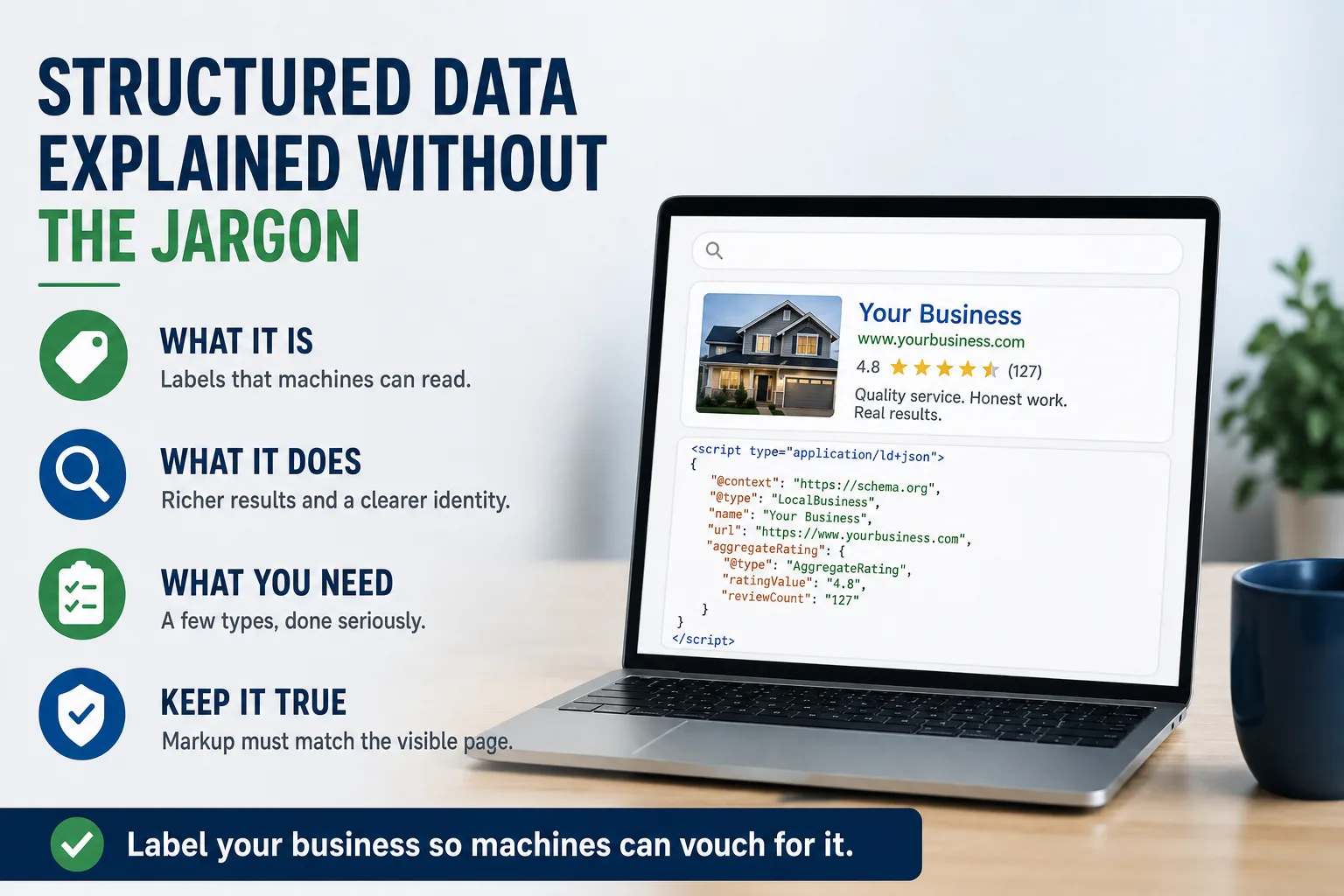
Somewhere in a proposal you have been handed, there is a line item that says "schema markup" or "structured data," and no explanation of what you are buying. It sounds like something only a developer could care about. It is actually one of the few technical items on a website that maps directly to something a business owner wants.
Here is the whole idea in one sentence: structured data is a small block of code that states, in a format machines read without guessing, what a page is about.
What the problem actually is
Your contact page says "Open 8–5 M–F" and lists an address. You read that and know instantly what it means. A machine reading the raw page sees a string of characters that might be opening hours, might be a phone extension, might be a product code. It can guess, and modern systems guess well, but guessing produces uncertainty and uncertainty is not what you want standing between you and a search result.
Structured data removes the guess. Instead of hoping Google infers your hours from a line of text, you also state them in a standardized vocabulary — Monday opens 08:00, closes 17:00 — that every major search engine has agreed to read. Same for your address, your phone number, the services you offer, the questions you answer, the trail of pages a visitor took to get here.
The vocabulary is Schema.org, maintained collaboratively by Google, Microsoft, Yahoo and Yandex. The format is a block of JSON sitting in your page's code, invisible to visitors. Nobody sees it. Everything that reads your site does.
What it does for you — and what it doesn't
Start with the honest part: structured data is not a ranking boost. Google has said so repeatedly. Anyone selling schema markup as a way to climb the results is either confused or counting on you being confused.
What it does is make you eligible for rich results — the search listings that are more than a blue link. The star ratings. The FAQ dropdowns that expand underneath a result. The business panel with hours and a map. The breadcrumb trail instead of a raw URL. Sitelinks. Event dates and prices.
The value there is real and measurable, just not where people expect it. A result with an expandable FAQ and a star rating occupies more vertical space and carries more information than the plain results around it, and tends to draw more clicks at the same position. You did not rank higher. You simply took up more of the screen and answered more of the question before anyone clicked.
The second benefit is growing faster than the first: AI systems reading your site to answer questions directly lean heavily on unambiguous, structured facts. That shift is significant enough that we gave it its own article.
The types a normal business actually needs
There are hundreds of schema types. A typical business needs a handful, and adding the rest is busywork.
Organization or LocalBusiness is the foundation — who you are, where, how to reach you, when you are open. If customers come to a location, use the most specific subtype that fits: not just LocalBusiness, but the medical, retail, or professional-service variant that describes what you actually are.
Service, one per service you want found. BreadcrumbList so search results show a readable path rather than a URL. FAQPage on pages with genuine questions and answers. Article on articles. Product or ItemList if you have a catalog. Person for named practitioners, principals, or anyone whose credentials are part of why someone hires you.
That is close to the entire useful list for most businesses. The work is not in choosing exotic types; it is in filling the common ones out completely and keeping them accurate.
The two rules that matter more than the markup
First: the structured data must match what a visitor sees. FAQ schema listing five questions that appear nowhere on the page is not clever, it is the fastest route to having your markup ignored — and, at scale, to a manual penalty. The same goes for hours, prices, and ratings that disagree with the visible page.
The engineering answer is to make drift impossible rather than to police it. On Gun Boss the FAQ schema and the visible FAQ accordion are generated from the same array, so the two literally cannot diverge; opening hours in the schema derive from the same source of truth that renders the hours on the page. Change one, both change.
Second: it has to stay true. Structured data is a set of factual claims about your business, and factual claims rot. A phone number changes, a suite number changes, holiday hours change, a certification lapses. Markup that was accurate at launch and wrong two years later is worse than none, because you have now stated something false in the format machines trust most.
What it looks like when it is done seriously
QTC, an FAA Part 145 aircraft component repair station, is the case where this stops being an SEO nicety. Their catalog runs to 597 parts across more than a thousand pages, and their buyers are sourcing engineers who search by part number, aircraft model, component type, and regulatory approval.
The schema layer there covers Organization, LocalBusiness, Service, BreadcrumbList, FAQPage, ItemList, Article and VideoObject — with the business name, address, phone and certificate numbers all deriving from a single source-of-truth module, so no page can drift out of agreement with any other. For a regulated business, that consistency is not a technical preference. It is the difference between being verifiable and being merely present.
The result is that a specialized repair station gets described to search engines with the same precision it uses on the shop floor — its approvals, its capabilities, its location, and every part it services, each one legible rather than buried in a taxonomy archive.
How to check what you have
Google publishes a free Rich Results Test: paste in a URL and it reports what structured data it found, which rich results you qualify for, and what is malformed. Schema.org's validator is more thorough and less opinionated. Both take a minute and neither requires you to understand the output — if the tool returns nothing, you have nothing, and that is the finding.
If you have markup but it is throwing errors, that is worth fixing before adding more. Incomplete or invalid schema is common on template-built sites, where a plugin generated something generic years ago that has quietly disagreed with your actual business ever since.
And if you are commissioning a new site, ask specifically: which schema types will this site have, and where do the values come from? "We'll add schema" is not an answer. "LocalBusiness, Service per service page, BreadcrumbList sitewide and FAQPage where there are FAQs, all generated from one config file so it cannot drift" is. That distinction is one of several worth raising before you sign anything — the rest are in What to Ask Before You Hire Anyone.