Qualified Technologies Corporation
A WooCommerce-to-static rebuild for an FAA and EASA certified aircraft component repair station — a 597-part catalog across 1,000+ pre-rendered pages, with a request-for-quote basket replacing the storefront checkout entirely.
Visit Live Site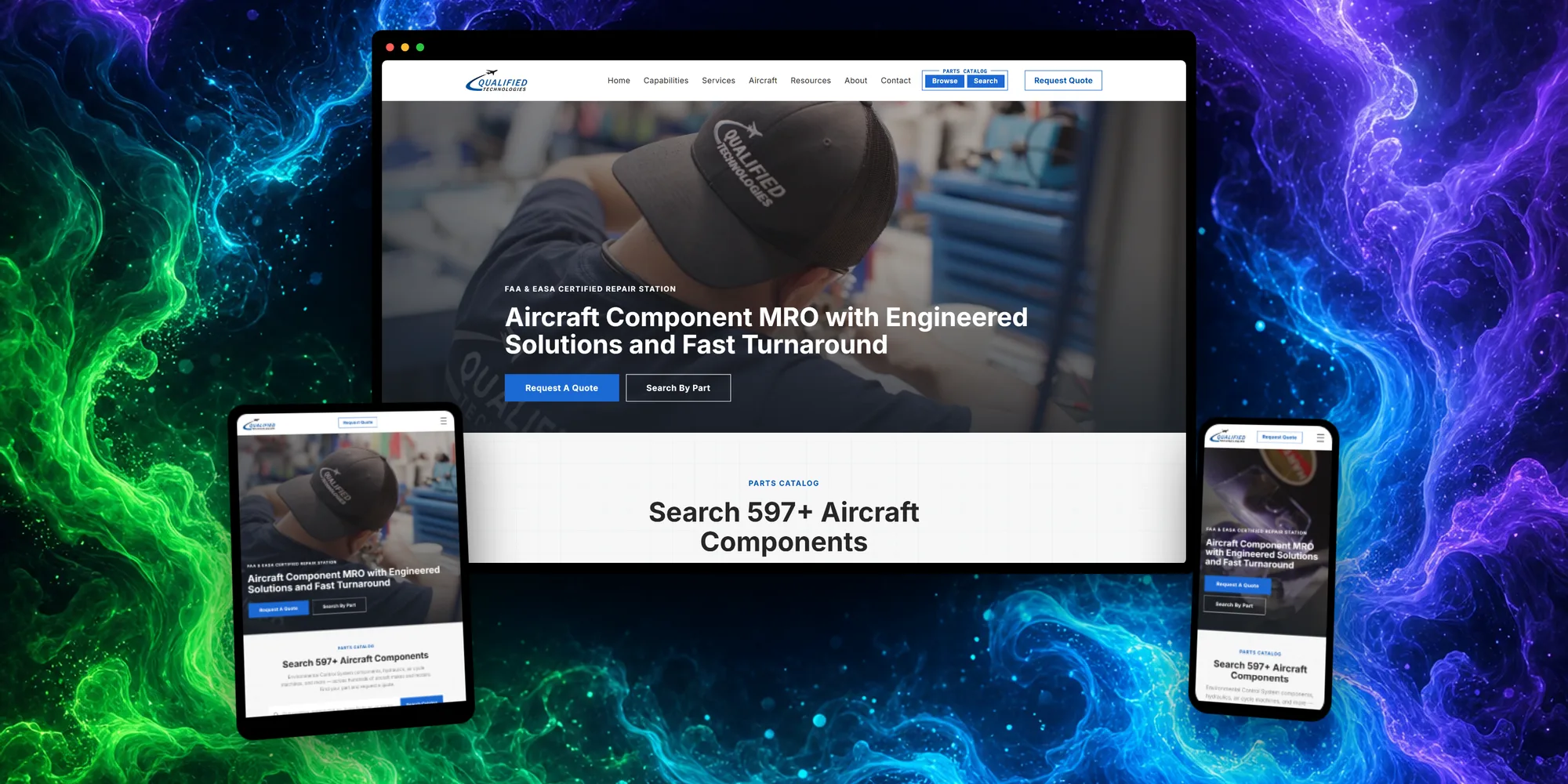
The Challenge
Qualified Technologies Corporation is an FAA Part 145 repair station in Upland, California, holding EASA and UK CAA Part 145 approvals alongside its FAA certificate. They specialize in environmental control systems — heat exchangers, air cycle machines, pneumatic valves, temperature sensors, and related components — for operators worldwide. Their site ran on WordPress with WooCommerce, and that was the core problem: WooCommerce is storefront software, and QTC does not sell parts off a shelf. Every transaction in component MRO starts as a request for quote against a specific part number, aircraft, and condition — not an add-to-cart. The site was carrying a payment stack, a cart, a checkout, and an account system for a business that needs none of them, along with the plugin surface and update treadmill that come with it. The catalog itself was the real asset and it was underserved: hundreds of part numbers sat in WooCommerce products with the aircraft make, model, and nomenclature buried in taxonomy terms, generating thin pages that gave Google almost nothing to rank. There was no capability structure, no certification pages, no location page, and no structured data — so a specialized repair station with three regulatory approvals was effectively invisible for the searches its customers actually run. And because this is a regulated industry, the rebuild carried a constraint most marketing sites do not have: every claim about scope, ratings, and airworthiness release had to be defensible, and none of the existing URLs could be allowed to break.
Our Solution
We rebuilt the site on Astro with static output, hosted on Render through a Blueprint. There is no server, no database, no payment stack, and no admin panel. The catalog moved to one markdown file per part in an Astro content collection, generated from a WP All Export CSV by a repeatable import script — taxonomy names are authoritative and the exported permalink supplies the exact existing slug, so every legacy /product/ URL survived the migration untouched. WooCommerce's checkout was replaced with what the business actually needed: a client-side quote basket held in localStorage, where a buyer collects part numbers with a condition on each line and submits one consolidated RFQ through Formspree. Nothing but that submission leaves the browser. On top of the catalog we built the site architecture the old one never had — a capabilities pillar with 16 component sub-pages, four service pages, an aircraft make-and-model hierarchy, OEM manufacturer pages driven by the manufacturer field on each part, dedicated FAA and EASA certification pages, and quality, location, and resources sections. Every product, nomenclature, and archive page was rebuilt from a bare table into a real page with a component overview, aircraft application, repair capability, related parts, and an FAQ. The structured data layer covers Organization, LocalBusiness, Service, BreadcrumbList, FAQPage, ItemList, Article, and VideoObject, with NAP and certificate numbers all deriving from a single source-of-truth module so no surface can drift. Sitemaps ship with image, video, and section children, and robots.txt blocks the query strings and legacy cart paths. Because the industry is regulated, we ran an explicit editorial control: every claim inferred rather than confirmed is flagged in source and tracked in a claims register for QTC to confirm, correct, or strike — the standing rule being that anything unsubstantiated gets removed rather than softened.
Results
QTC launched at qtc.aero as a fully static site — 597 catalog parts rendered across more than a thousand pre-rendered pages, served from a CDN with no database and no plugins behind them. The WooCommerce cart, checkout, and payment surface are gone entirely, replaced by an RFQ flow that matches how component MRO is actually bought. SEO equity carried over rather than being rebuilt from scratch: product slugs are preserved exactly, and 29 redirect rules map the remaining legacy URLs, with the apex set as the single canonical host and www 301-ing to it path-for-path. For the first time the repair station's FAA, EASA, and UK CAA approvals, its Upland facility, its ECS capability list, and its OEM coverage each have a dedicated, structured, indexable page instead of living in a taxonomy archive. Catalog updates now run through a CSV re-import and a Git push instead of a WordPress admin session, and there is no plugin update that can take the site down.
Thanks to Kevin, and Amanda, and their crew, our company Website now represents a very valuable piece of our marketing and sales program, and we are so proud of its performance that we share it whenever an opportunity appears. Previously, with slow response, broken links, and outdated form and function, our site showed up far down a google search listing and left my customers wondering what or who they were dealing with.
Our site today boasts an incredible score of 400 out of 400, on elements such as speed, security, as well as “look and feel”. As a result, it shows up much earlier in a search, and my customers are using it to request quotes and pricing and comment on how well it works even when they are using their phones, something even my competitors cannot match.
Neuron personnel were extremely competent, professional, and quick to resolve questions, and we would recommend their services to any one; Neuron is a reasonable and efficient service!!!
Sam Qubain
CEO, Qualified TechnologiesRelated reading
The thinking behind this build, written for business owners.
- Search & SEO7 min read
Structured Data, Explained Without the Jargon
Schema markup is the least understood and most quietly valuable thing on a business website. What it is, what it actually does for you, and which types a normal business needs.
Read the article - Performance6 min read
Why Manufacturer Websites Fail Google's Speed Test — and What It Costs
Most manufacturing websites we test score under 50 on Google PageSpeed. Here's why it happens, what it costs in RFQs and rankings, and what the fix actually looks like.
Read the article - Website Economics7 min read
Rebuild or Repair? A Framework for an Aging Website
Rebuilding a website that only needed maintenance wastes money. Maintaining one that needed rebuilding wastes more. Five questions that tell you which situation you are in.
Read the article
Want results like these?
Tell us about your project and we will show you what we can build.