How AI Search Changed What Your Website Needs to Say
AI systems increasingly answer your customer's question instead of handing them ten links. Getting cited in that answer depends on things most business websites happen to be bad at.
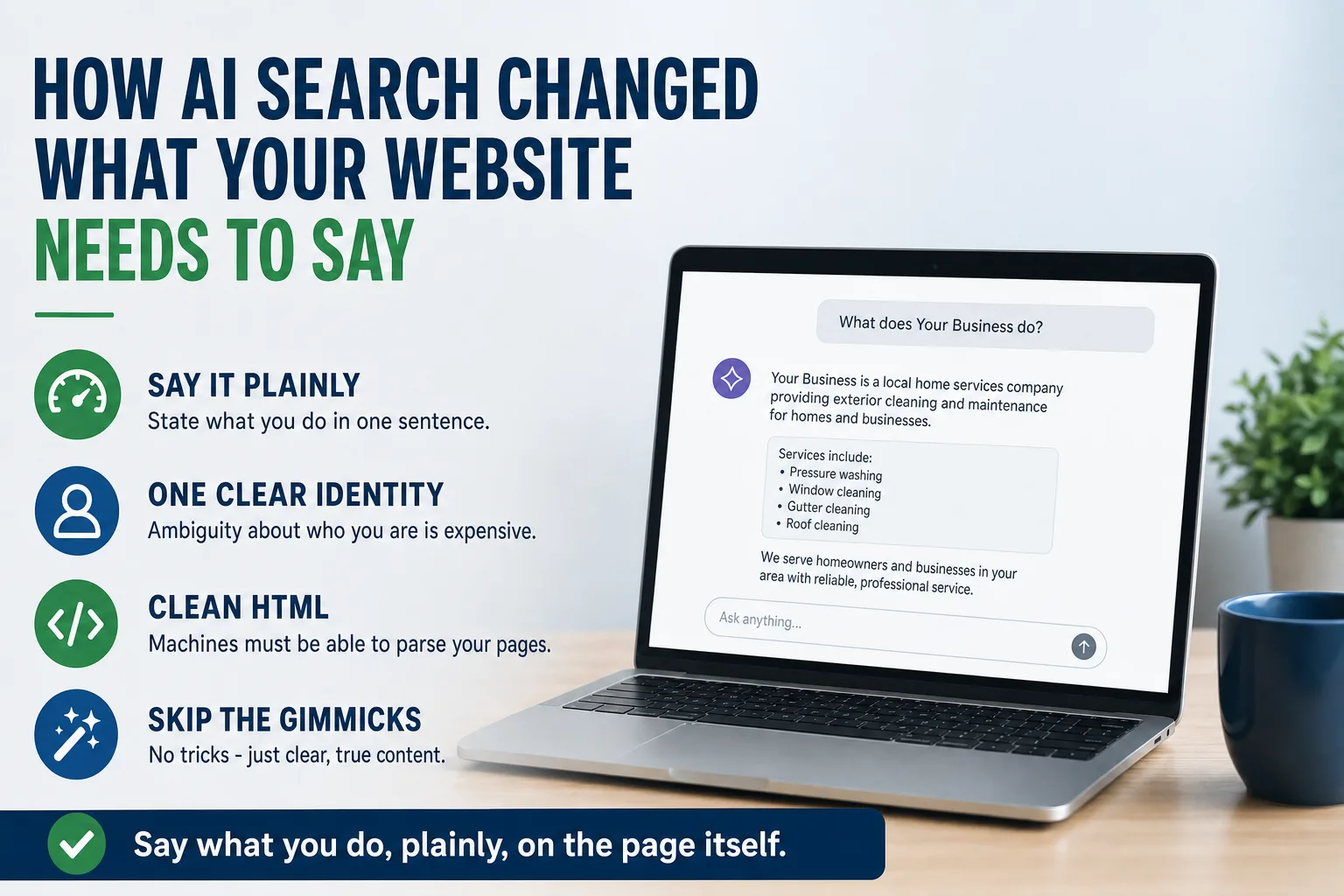
A customer used to search, get ten links, and click one. Increasingly they search, read a synthesized answer at the top of the page, and click nothing — or they skip the search engine and ask an assistant directly.
This is unsettling for anyone whose business depends on being found, and the anxious framing is everywhere: AI is going to kill your website traffic. The more useful framing is narrower. The question is no longer only whether you rank. It is whether, when a machine assembles an answer about businesses like yours, your business is in it and attributed to you.
The good news is that the work is not exotic. It is largely the same fundamentals, applied more strictly, because machines are less forgiving readers than people.
What these systems are actually doing
Whether it is an AI overview in search results, an assistant answering a question, or a chatbot with browsing, the mechanic is broadly similar: retrieve some relevant sources, extract the facts that answer the question, compose a response, and cite what it used.
Two things follow from that. First, being retrievable matters — your page has to be findable and readable by the crawlers these systems use. Second, being extractable matters, and this is the part most business sites fail. A page can be perfectly ranked and still contribute nothing to a synthesized answer, because it never states a clear fact in a clear sentence. Marketing prose is optimized for feel. Extraction wants assertions.
Say the thing, in a sentence, in the page
Consider two ways of conveying the same information. "With decades of combined experience, our team is proud to serve the greater Phoenix area with a comprehensive suite of residential solutions." Versus: "Ancla Plumbing is a licensed, insured residential plumber serving Phoenix and the East Valley, available 24/7, with Arizona ROC licenses for both commercial and residential work."
A human skims both and gets a vague impression from the first, a specific one from the second. A machine extracts nothing usable from the first and four checkable facts from the second — what the business is, where it operates, when it is available, what it is licensed for.
This is the single highest-leverage change most sites can make, and it costs nothing but a willingness to be plain. State what you do, where you do it, who you do it for, what it costs or what the range is, how long it takes, and what qualifies you. In sentences. Near the top. Not implied by a photo carousel.
The same instinct applies to questions. If customers ask whether you pull permits, put a heading that asks whether you pull permits and answer it in the following sentence. Question-and-answer structure is unusually easy to extract and happens to be good for human readers too, which is why it survives every change in how search works.
Ambiguity about who you are is now expensive
These systems are trying to resolve entities — to determine that the business on this page is the same business as the one on that directory listing and that review page. When the details disagree, confidence drops, and low-confidence entities do not get cited.
So the unglamorous consistency work described in What It Actually Takes to Rank in Your Own City has a second payoff here. One canonical name, address, and phone number everywhere. Structured data stating your identity as machine-readable fact rather than leaving it to be parsed out of a footer. Named people with real credentials, so expertise attaches to someone specific.
This is where structured data has quietly gained importance. It was always the clearest way to state facts to a machine. Now considerably more machines are reading.
Clean HTML stopped being a preference
A crawler that has to execute JavaScript to see your content may or may not bother, and may or may not wait long enough. Content that exists in the HTML the moment the page is served is content that every system can read on the first pass. Content painted in afterward by a framework is a gamble whose odds vary by which system is looking.
Static architecture happens to be ideal for this, not because anyone designed it for AI, but because pre-rendering every page into plain HTML at build time is exactly what a machine reader wants — no execution, no waiting, no ambiguity about whether the important paragraph loaded. It is the same property that makes those sites fast for people. When we built Full Tech Ahead, a technology podcast consolidating five scattered platforms into one destination, that clean semantic markup was an explicit goal alongside conventional SEO — content that search engines and AI models can parse without a fight.
The correlation is convenient and not coincidental. Pages that are fast, semantic, and structured are pages that are legible, and legibility is the whole game for both audiences.
What not to do about it
Do not block the crawlers reflexively. There is a real debate about AI systems using content without compensation, and it matters enormously for publishers whose product is the content itself. For a business whose website is marketing, the calculus is inverted: you want to be quoted. Being cited as the answer to "who does commercial roofing in Riverside" is the outcome, not the theft.
Do not buy an "AI optimization" package that is conventional SEO with new vocabulary on the invoice. Ask what specifically would change on the site. If the answer is clearer factual statements, better structured data, consistent entity information, and cleaner markup — that is legitimate, and it is also just good practice. If the answer involves proprietary techniques for ranking in language models, it is not a real product.
And do not rewrite your site to read like a machine wrote it. The pages that get cited are specific, factual, and well organized. That describes good business writing. It has never described keyword-stuffed filler, and the systems reading now are considerably better at telling the difference than the ones that came before.
The short version
Everything that makes you legible to an AI system was already worth doing: state facts plainly, structure them clearly, keep your identity consistent everywhere, publish real evidence of expertise, and serve clean HTML fast.
What has changed is the penalty for vagueness. A site full of confident-sounding nothing used to cost you a little conversion. Now it also costs you the citation, because there was no fact in it to extract.