What to Ask Before You Hire Anyone to Build Your Website
Ten questions that separate a vendor who will still be useful in year three from one who will not — and the answers that should end the conversation.
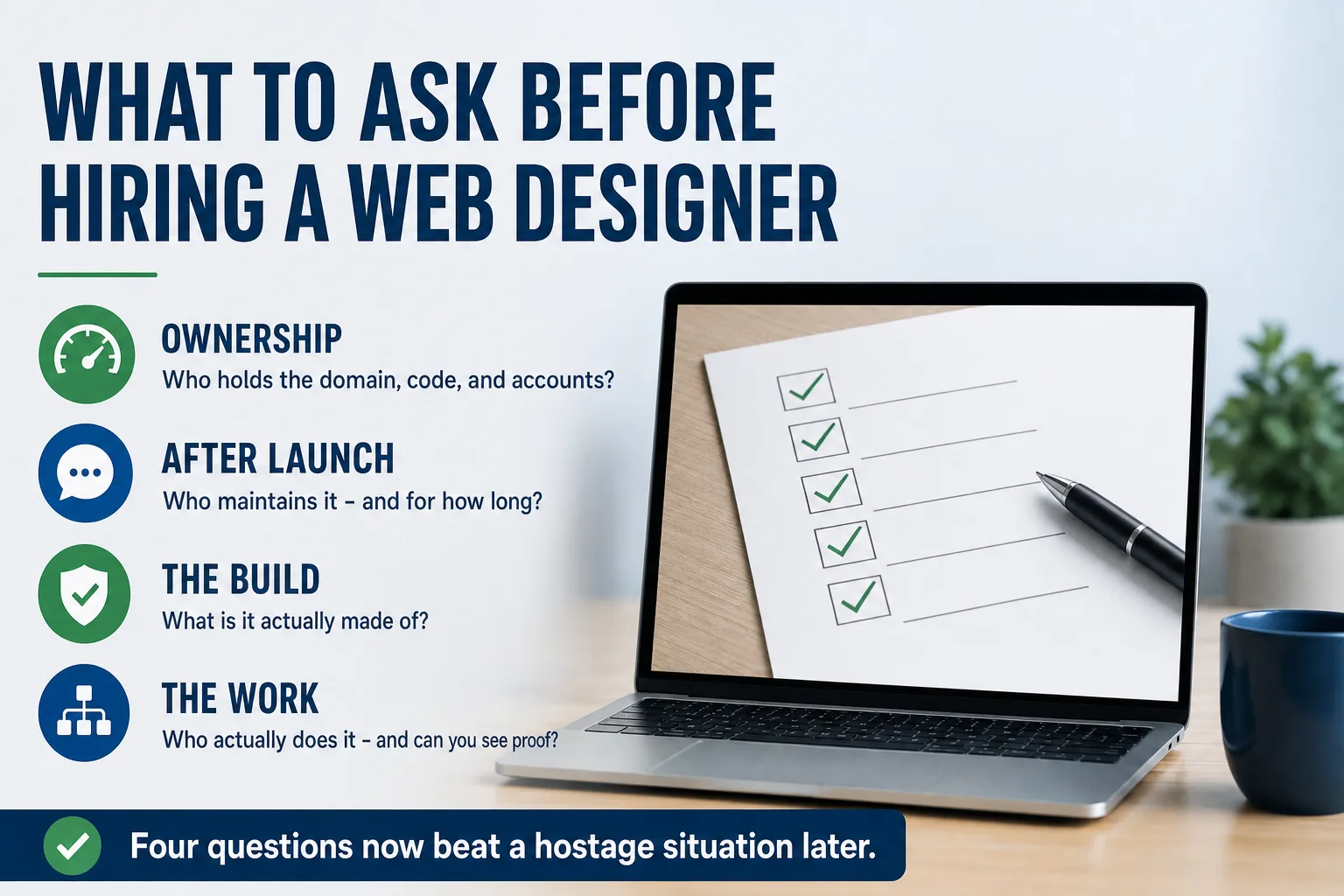
Most website purchases are made by someone buying a website for the second or third time in their life, from someone who sells them every week. That asymmetry is the actual problem — not dishonesty, just the ordinary gap between a specialist and a generalist, which shows up as a quote you cannot really evaluate.
These are the questions that close the gap. They are deliberately unclever; the point is that they are hard to answer vaguely, which makes vagueness itself the signal.
Ownership
1. When this is finished, what exactly do I own, and can I take it to another developer? You want a specific answer covering the domain, the site files or repository, and the content. "You own your website" is not an answer — every vendor says that, including the ones whose platform makes leaving impossible.
2. Whose account will my domain be registered in? The correct answer is yours. A vendor who wants to hold your domain for convenience is proposing an arrangement where your web address and email depend on their continued goodwill. Deeper on this in Who Actually Owns Your Website?.
3. Will I be the owner of my own Google Business Profile, Analytics, and Search Console? Owner, not manager. These get created under vendor accounts constantly, and analytics history in particular cannot be recovered later.
What happens after launch
4. Who maintains this, what does it cost, and what is your response time when I need a change? The most consequential question and the one most often left fuzzy. You want a named responsibility and a stated commitment. "We're always available" is not a commitment; "changes acknowledged within one business day" is.
5. What happens if the site breaks on a Saturday? Every site eventually has a bad day. The useful information is whether there is a defined path, or whether it depends on catching one person's attention.
6. What does this cost me every month, itemized, for the next three years? Hosting, maintenance, plugin and theme licenses, SSL, forms, anything else. The build quote is the smallest number in the site's life, and the recurring stack is where platforms actually differ — the full arithmetic is here.
How it is built
7. What is it built on, and what is the maintenance burden of that choice? You are not looking for a specific technology so much as whether the vendor can explain the trade-off. A platform requiring frequent updates and plugin management is a legitimate choice if someone is committed to doing it. It is a poor one if the plan is to hand you the keys and wish you luck.
8. What PageSpeed score will it launch at, and will you put that in writing? A reasonable builder will commit to something. This question tends to produce the most revealing responses in the whole list, because the answer is objectively checkable the day the site goes live — and the follow-up matters just as much: what keeps it there in year two? We cover why that number is a business figure rather than a technical one in Is a Fast Website Worth It?.
9. What structured data will the site have, and where do those values come from? "We'll add schema" is a non-answer. A real one names the types and, ideally, describes them deriving from a single source so the markup cannot drift from the page. See Structured Data, Explained Without the Jargon.
The one about the work itself
10. Can I see three sites you built more than two years ago, and can I run them through PageSpeed right now? Anyone can show you a portfolio of launches. The question is what those sites look like after they have been lived in — because a site that scored 100 at launch and 40 today tells you exactly what the architecture does over time, and that is the thing you are actually buying.
Then call one of those clients. Ask what happens when they need something changed. Two minutes of that is worth more than the entire proposal.
Answers that should end the conversation
Evasion about the domain. There is no legitimate reason a vendor needs to hold your web address in their own account.
A quote with no recurring costs at all. Every website has ongoing costs. A proposal that shows none has either hidden them or has not thought about year two, and both are the same problem arriving later.
Guaranteed first-page rankings. Nobody can guarantee this, Google says so explicitly, and offering it marks a vendor as either uninformed or comfortable telling you things that are not true.
Pressure to sign today. Websites are not perishable. A discount that expires this afternoon is a technique, not a price.
And the subtle one: an inability to say what they would not do. A vendor who thinks every business needs a rebuild, a blog, and a monthly SEO retainer is describing their product line rather than your situation. The most useful thing we tell prospective clients is fairly often "do not rebuild this yet, fix these three things and call us in a year."
What good looks like
A vendor who answers all ten without hedging, states their pricing openly rather than quoting on discovery of what you can afford, commits to a performance standard in writing, and tells you plainly what is not included. You should finish the conversation knowing what you own, what it costs every month, who to call, and how fast they answer.
Ours are published — build packages and care plans with what is in each, on the pricing page, including the parts that are not flattering. You are welcome to use this list on us, and on everyone else you are considering. If we come out badly on a question, that is information you should have before you spend the money, not after.