Neuron Computers
A managed IT provider was losing prospects to a 6.8-second WordPress site — bounce rate at 71%, PageSpeed at 34. For a company selling uptime to manufacturers and government contractors, its own website was the counter-argument. We rebuilt it static across 22 pages.
Visit Live Site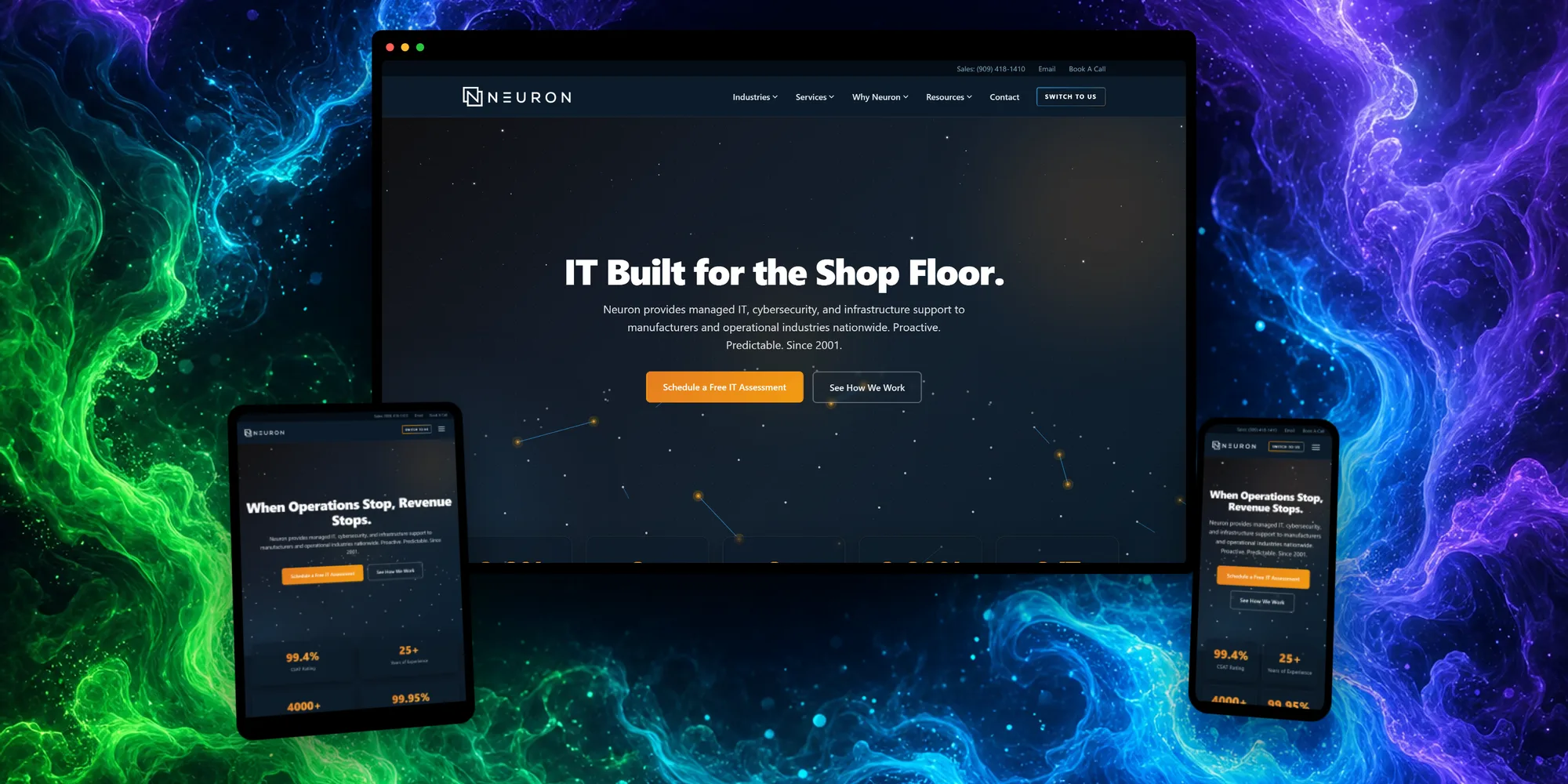
The Challenge
Neuron Computers had been running their website on WordPress for over six years. What started as a simple five-page site had ballooned into a bloated mess of plugins, outdated themes, and security patches that broke more than they fixed. Page load times averaged 6.8 seconds on mobile. Their Google PageSpeed score sat at 34 for Performance and 52 for Accessibility. Potential clients in manufacturing and government contracting were bouncing before the homepage even finished rendering — the bounce rate had climbed to 71%. For a company that sells IT infrastructure to businesses that demand uptime and reliability, the website was actively undermining their credibility. They needed to communicate the depth of their managed IT services across five industries while supporting compliance messaging for CMMC, NIST 800-171, and ITAR — and they needed the site itself to prove they understood performance.
Our Solution
We stripped everything back to zero and rebuilt from the ground up on Next.js with static generation. No WordPress. No database. No plugins. Every single one of the 22 pages is pre-rendered at build time and served as pure HTML from a global CDN. We implemented a dark-mode design system with glassmorphism effects, scroll-reveal animations, animated stats counters, and dedicated industry pages — each with structured JSON-LD data for search engines. The architecture uses markdown-driven content so updates deploy in seconds through Git, not through a fragile admin panel. Images are optimized at build time, CSS is purged to only what each page uses, and there is zero render-blocking JavaScript. We added semantic HTML throughout, skip-link navigation, proper heading hierarchy, and ARIA labels to push accessibility to a perfect score.
Results
The results were immediate and dramatic. Google PageSpeed jumped from 34 to a perfect 100 for Performance. Accessibility went from 52 to 100. Best Practices and SEO both hit 100 — a clean sweep across all four Lighthouse categories. Page load times dropped from 6.8 seconds to under 400 milliseconds, a 94% improvement. The bounce rate fell from 71% to 38% within the first month as visitors actually stayed to read the content. Contact form submissions increased by 85% compared to the same period on the old WordPress site. Organic search impressions doubled within 90 days as Google rewarded the faster, more accessible, properly structured pages. The site now serves as the anchor project for the Neuron Web Development portfolio and living proof of what static architecture delivers over WordPress.
Before the rebuild, the site we replaced scored 34/400 on the same four Lighthouse categories.
Related reading
The thinking behind this build, written for business owners.
- Performance9 min read
Is a Fast Website Worth It? The Business Case for Speed
Page speed gets sold as a technical virtue. It is actually a margin question — it decides how much of your traffic survives to become a lead. Here is how to price it for your own business, including when it is not worth it.
Read the article - Performance6 min read
Why Manufacturer Websites Fail Google's Speed Test — and What It Costs
Most manufacturing websites we test score under 50 on Google PageSpeed. Here's why it happens, what it costs in RFQs and rankings, and what the fix actually looks like.
Read the article - Website Economics6 min read
Static vs. WordPress: The Real Total Cost of a Business Website
The build quote is the smallest number in your website's life. A clear-eyed comparison of what WordPress and managed static architecture actually cost over three years.
Read the article
Want results like these?
Tell us about your project and we will show you what we can build.