Website Traffic Dropped? When to Worry and When It Does Not Matter
Fewer visitors is not the same as fewer customers. How to tell a harmless traffic drop from one that costs you leads, in about an hour.
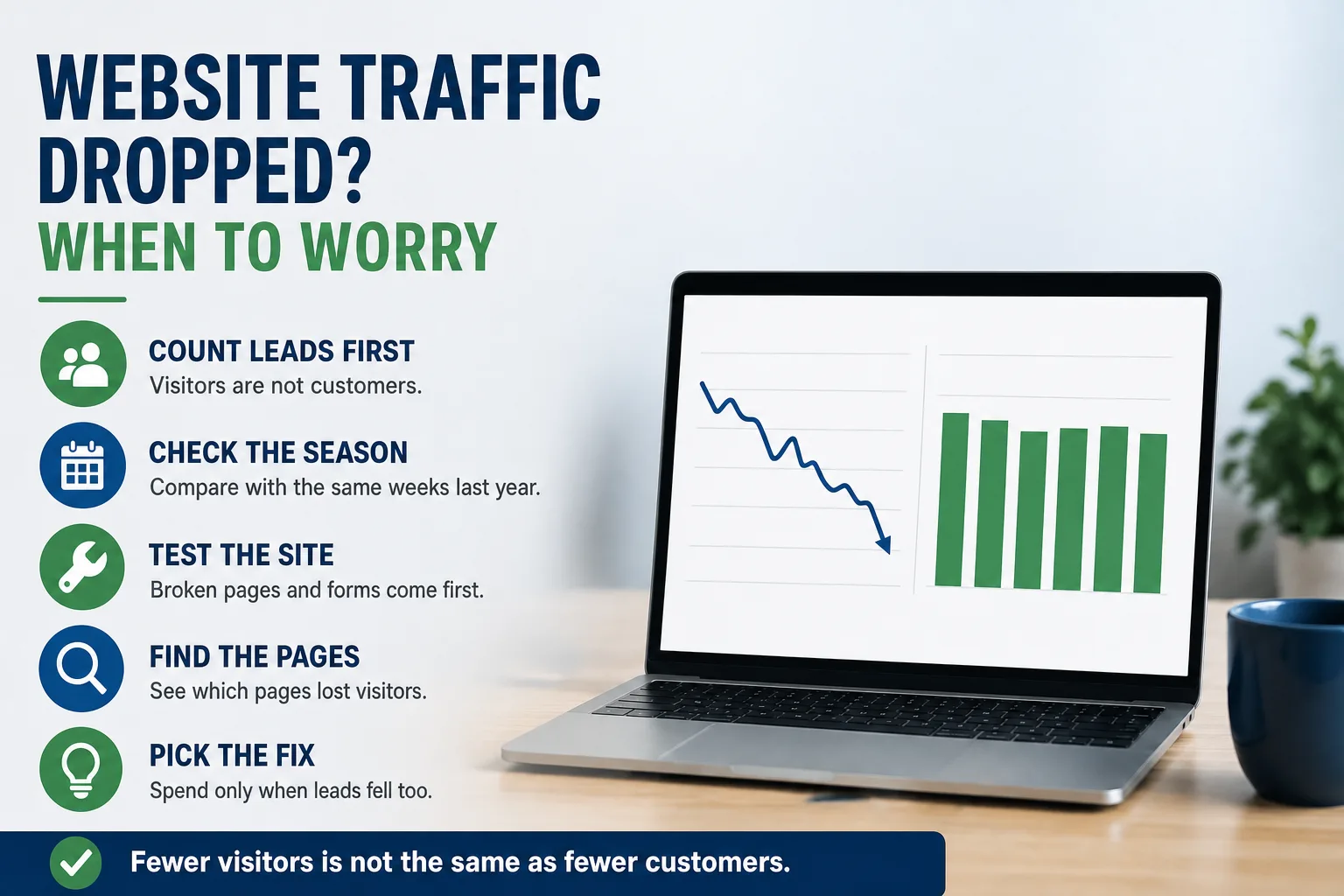
The monthly report lands on a Monday. Website visitors are down by a third. Your marketing person has flagged it in red. Someone has already forwarded it to you with one word: "Thoughts?"
It is a fair question, and the honest answer is that a traffic number on its own tells you almost nothing. Some drops are an emergency. Many are harmless. A few are actually good news.
The difference comes down to one question you can answer before lunch. Did the calls, quote requests, and orders drop too?
Visitors are not customers
A website report counts every visit the same way. A purchasing manager comparing three suppliers counts as one. So does a student researching a school project, a job seeker, a competitor checking your prices, and an automated program that reads websites all day.
For a business that sells to other businesses, most of that traffic was never going to buy. If you lose a pile of visitors who were never buyers, the chart goes down and nothing in your business changes.
So before anyone touches the website, count the things that pay the bills. Form submissions. Calls from the website number. Quote requests. Orders. Compare the last 90 days with the 90 days before, and with the same 90 days last year.
If those held steady, you do not have a revenue problem. You have a reporting question, and it can wait for a calm afternoon. If those fell too, keep reading, because now it matters where the drop came from.
Why traffic falls when nothing is wrong
Google answers more questions directly on the results page now, with a written summary above the links. People get what they needed without visiting anyone. A 2025 Pew Research Center study found that when Google showed one of those summaries, people clicked a regular search result about half as often.
The visits you lose that way tend to be the easy, general questions. What does a backflow test involve? What is the difference between two grades of steel? Those readers were learning, not shopping. The buyer who wants a quote from someone in their region still has to find a company and pick up the phone. We wrote more about this shift in how AI search changed what your website needs to say.
Seasons matter too. Google's own guidance on traffic drops tells site owners to look at a long stretch of history, so they can see whether the same dip happens every year. A roofing company is busier before the rains. A distributor slows down over the holidays. If last October looked like this October, you are looking at a calendar, not a crisis.
Then there is housekeeping. If your site recently stopped counting automated visitors, or someone changed the tracking settings, the number can fall overnight without a single real person going missing. Ask whoever runs the reports whether anything changed in how visits are counted.
When a drop deserves attention this week
Some drops are real, and the warning signs are specific. Leads fell at the same time as visitors. The drop was sudden, over a few days, rather than a slow slide. Or it hit the pages that actually sell: your service pages, product lines, and the page that says where you work.
Sudden drops usually have a cause you can find. The most common is that something broke. The site went down for a stretch, a page started showing an error, the contact form stopped sending, or a security warning appeared in front of visitors. Google's documentation lists exactly these problems, along with site redesigns, as common reasons search traffic falls.
A redesign is the one owners forget. If the site was rebuilt or reorganized recently and the old page addresses were not pointed at the new ones, Google can lose track of pages that used to bring in buyers. Those losses show up on the pages that matter most, a few weeks after launch.
The last cause is Google itself. It changes how it ranks results several times a year. A business can slip after one of those updates without having done anything wrong, simply because a competitor now answers the buyer's question better.
A one-hour check you can run yourself
You do not need an agency for the first pass. You need an hour and the right order.
First, count leads, not visits, for the same two periods. If they held, stop here and put the rest on the calendar for next quarter.
Second, compare the drop with the same weeks last year. If last year dipped too, it is probably the season.
Third, use the site the way a buyer would. Open it on your phone. Visit your three most important pages. Submit your own contact form and confirm it arrives. If anything is broken, that is your answer, and fixing it comes before anything else. Our contact form article walks through the silent ways a form fails.
Fourth, look at which pages lost visitors. Google Search Console (Google's free report on how your site appears in its results) shows this page by page. Ask whoever manages your site to pull it for you. Losses spread thinly across old blog posts are rarely worth chasing. Losses concentrated on a service page are.
Fifth, write down when the drop started. Match that date against anything that happened: a redesign, a new vendor, a change to the hosting, a Google update. A date and a cause together usually point straight at the fix.
What to do with what you find
If leads are steady, resist the urge to spend money. A redesign will not bring back visitors who were only looking for a definition. Change what you report instead. Put leads at the top of the monthly summary and visits underneath, so nobody panics over the wrong number again.
If something broke, fix it and then ask why nobody noticed. A site that fails quietly will fail quietly again. Someone should be watching it every day, and a form test should be on a calendar. That is the kind of oversight we build into every site we manage, because the first person to notice an outage should never be a customer.
If a redesign lost your old page addresses, it is often recoverable. The old addresses can still be pointed at the new pages, and much of the lost ground tends to return as Google catches up. Act quickly, though. The longer old links lead nowhere, the harder the recovery.
If you slipped after a Google update and the site works fine, the answer is slower. Look at the pages that lost ground and ask honestly whether they answer a buyer's question better than the competitor who passed you. Clear prices or price ranges, real project photos, service areas, and plain answers to common questions tend to do more than any trick.
And if the numbers say leads really are down and none of this explains it, that is a bigger conversation. Start with the six reasons a website stops producing leads and work through them in order.