How to Get Google Reviews When You Sell to Other Businesses
Google's review rules are stricter than most owners realize. How to ask business customers for reviews the right way, and what to do when a bad one lands.
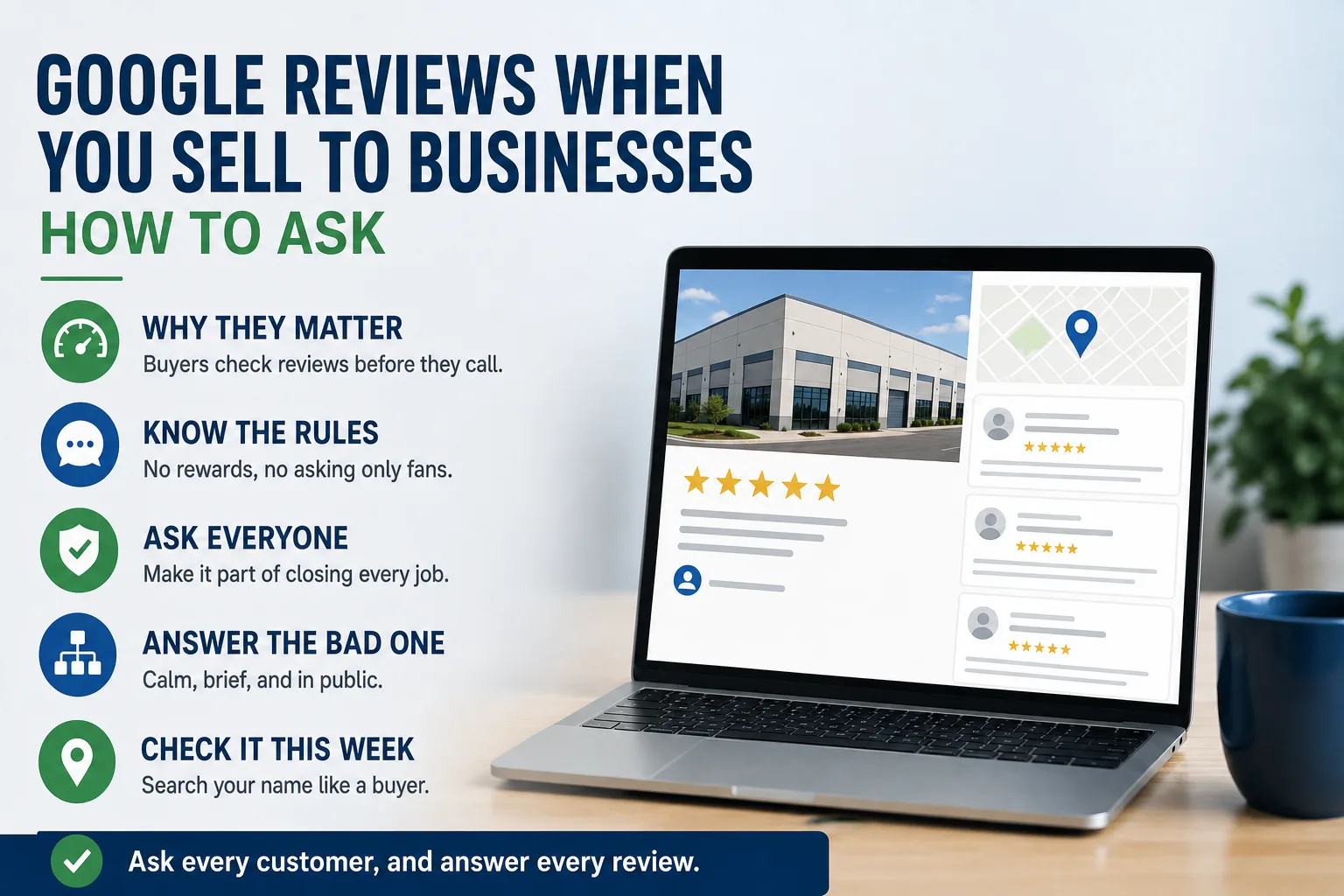
A plant manager needs a new mechanical contractor before the end of the month. The manager searches three company names on a phone between meetings. One has a steady stream of recent reviews, each with a short reply from the owner. One has a handful from years ago. One has none.
Nobody calls the third company first. It might be the best of the three. The buyer has no way to know, and no time to find out.
Most companies that sell to other businesses treat Google reviews as something for restaurants. They are not. They are the first reference check a new buyer runs, before anyone asks you for references. And the rules for collecting them have gotten stricter, in ways that catch careful businesses off guard.
Why reviews matter when your buyer is another business
A business buyer is rarely spending their own money. They have to explain the choice to a boss, a committee, or a purchasing department. A page of recent, specific reviews gives them something to point at. It makes choosing you feel safe.
Reviews also affect whether you show up at all. Google's own guidance on local ranking says that more reviews and positive ratings can help a business rank. We covered the rest of that picture in what it takes to rank in your own city.
The catch for a business that sells to businesses is volume. A plumber finishes several jobs a day. A fabrication shop or a logistics firm might close a handful of big projects a quarter. Every review is scarce, so every one is worth asking for properly.
The rules are stricter than the law
Google's review policy spells out what a business may not do, and much of it surprises owners. You may not offer anything in exchange for a review. That means no gift cards, no discounts, and no entry into a drawing. You may not ask only your happy customers, or steer unhappy ones somewhere private instead.
The policy also covers your staff. You may not require employees to collect a set number of reviews. You may not ask customers to mention a staff member by name. And you may not pressure anyone to write a review while they are standing in your shop or office.
Reviews from people with a conflict of interest are not allowed either. That includes current and former employees, contractors, family members, and competitors. Google says it removes content that breaks these rules, and can restrict or close accounts that keep breaking them.
Federal law sits underneath this. The Federal Trade Commission rule on consumer reviews took effect on October 21, 2024. It bans fake reviews, undisclosed reviews from company insiders, and using threats to get bad reviews taken down. Interestingly, the law is looser than Google on one point. It allows some rewards for reviews, as long as the reward does not depend on the review being positive. Google allows none. On Google, follow Google.
How to ask, the right way
Ask everyone, at a natural moment. For most companies that sell to businesses, the moment is the end of a project, a signed completion, a delivery accepted, or a renewal. Pick one and make the ask part of closing out every job. Asking everyone keeps you inside the rules. It also makes the reviews more believable, because a perfect score with no complaints reads as staged.
Ask the right person. The purchasing department signed the order, but it did not live through the project. The site supervisor, the office manager, or the engineer who worked with your crew has something specific to say. Specific reviews are the ones buyers trust.
Make it personal and easy. A short note from the owner or the project lead works better than an automated blast. Include the direct review link, which you can copy from your Google Business Profile. Do not tell them what to write. Do not suggest they name your best technician, even if they would want to.
Expect some polite refusals. Some larger companies do not let employees endorse vendors in public. That is not a bad sign. Thank them, and ask whether they would be a reference by phone instead.
When a bad review lands
Wait a day before you reply. The first draft of a reply to an unfair review is almost always too long and too angry.
Then check who wrote it. If it is a real customer, reply in public, briefly and calmly. Acknowledge the problem, state one fact if the review gets something wrong, and offer to talk directly. Remember who the reply is for. It is not really for the reviewer. It is for the next buyer reading both, and that buyer is judging how you handle problems.
If the review breaks Google's rules, report it. That covers a person who was never a customer, a competitor, a former employee, or an off-topic rant. You can flag it from your Business Profile. Google decides, and it will not always agree with you.
What you must never do is threaten the reviewer or offer them something to take it down. That is exactly the conduct the federal rule targets. One honest bad review among many good ones rarely costs you work. A public fight over it can.
Put the reviews where buyers already are
Reviews live on Google, but buyers also read your website. Link to your reviews from the site, and quote a few strong ones on the pages that describe the matching service. Use them word for word, with the reviewer's name or company only if you have their permission.
A buyer who reads your site should never wonder whether real customers exist. If your site is getting visits but no calls, weak proof is one of the usual suspects in why a website fails to produce leads.
AI assistants are also starting to answer questions like "who is a good contractor near me." They draw on what is public about your business, and your reviews are part of that record. More on that in how AI search changed what your website needs to say.
A review check you can run this week
Search your company name on your phone, the way a buyer would. Look at what shows up before anyone reaches your website. Note how recent the latest review is, and whether each one has a reply.
Then do three things. Reply to every review that has no answer yet, good or bad. Write a short, plain ask you can send at the end of every project. And make a list of the jobs you finished in the last few months, then send that ask to the person who worked with you on each one.
Finally, make sure nobody on your team is running a review contest or tying a bonus to review counts. Those were common habits, and they now break the rules.
Keeping an eye on your profile and reviews is part of what we handle for clients under our concierge service. But everything above works without us. If the check turns up something odd, like a listing you did not create or reviews that vanished, we are glad to take a look.