Who Inside Your Company Should Be in Charge of the Website?
Sales thinks marketing has it. Marketing thinks the vendor has it. How to pick one person to own the website, what the job involves, and the time it takes.
A customer calls to ask why your website still lists a product line you dropped two years ago. Sales says they told marketing. Marketing says the web company handles that. The web company says they are still waiting for someone to send the new wording. Nobody is wrong, and nothing has changed in months.
That is what a website with no owner looks like inside a company. It is not broken. It just drifts away from the business it describes, one small out-of-date detail at a time.
Most companies with ten to a few hundred people never decide who is in charge of the website. It lands on whoever was nearest when it launched. Here is how to pick that person on purpose, what the job actually involves, and how little time it takes when it is set up well.
Why the website ends up belonging to nobody
A website touches sales, marketing, operations, hiring, and IT. That is exactly why nobody owns it. Each department uses a piece of it and assumes another department minds the rest.
The usual default is the IT person, because a website feels like technology. But the hard questions about a website are rarely technical. Is this still what we sell? Are quote requests reaching sales? Is that still our team? Those are business questions, and the IT person is often the last to hear the answers.
The other default is the outside web company. A good vendor does a lot. But they cannot know that your service area changed, that a key person left, or that a new certification came through. They only know what someone inside tells them.
This matters more than it used to. Buyers now ask AI assistants to compare suppliers, and those tools describe your company using what your website says. A stale page used to cost one confused phone call. Now it can be repeated, with confidence, to buyers you never hear from. We covered that shift in how AI search changed what your website needs to say.
What the job actually is
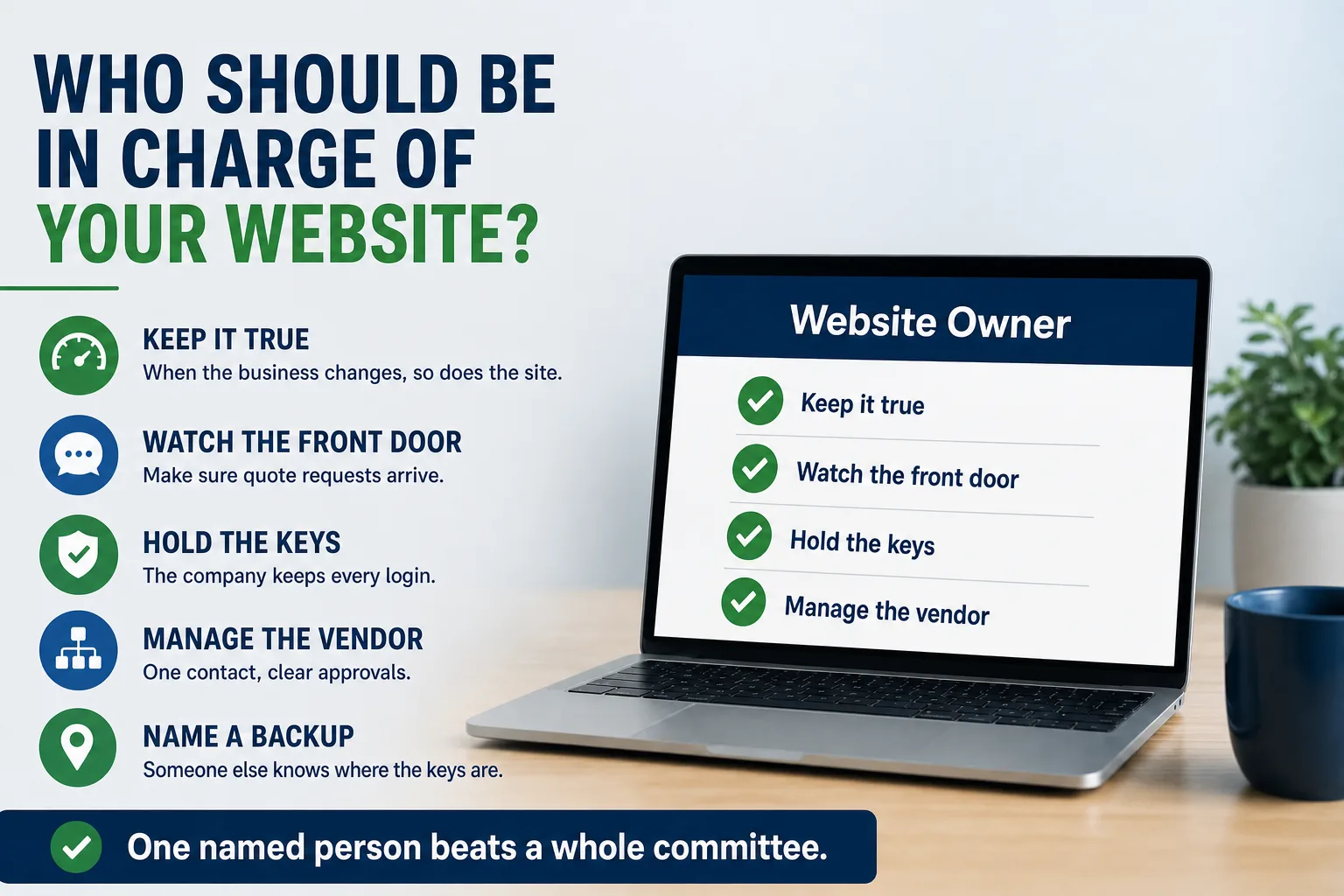
The job is not building pages or fixing things. It is being the one person who notices, decides, and follows up. In practice that comes down to four duties.
Keep it true. When the business changes, the website changes. A new service, a dropped product, a new phone number, a new location, someone joining or leaving the team. The owner is the person the rest of the company tells, and the person who makes sure it happens.
Watch the front door. Every month, confirm that quote requests are arriving and that someone answers them. A form can stop delivering while looking perfectly fine, as we explain in why nobody fills out your contact form.
Hold the keys. Know where the logins live for your web address, your hosting, and your Google listings, and make sure the company holds them rather than one employee or one vendor. Who actually owns your website walks through that list.
Manage the vendor. Be the single point of contact. Approve changes, read the monthly report, and ask when something looks off.
Notice what is missing from that list: design skills, writing skills, and technical skills. The owner can hand all of that off. What they cannot hand off is caring whether it is right.
Who usually makes the best owner
In most companies this size, the best owner is someone close to customers, with enough standing to get answers from other departments. Often that is an operations manager, a sales manager, or an office manager who hears about changes before anyone else does.
Title matters less than reach. The person needs to be able to ask the sales manager what changed in the price list and get an answer that week.
Three common picks tend to fail. The founder, unless the company is small enough that they will really do it, because the website loses to everything else on their desk. A junior hire with no authority, who will spot problems and have no way to fix them. And a committee, because a website with five owners has none.
If you cannot choose between two people, pick the one who takes the customer calls when the website is wrong. They already have a reason to care.
How much time it really takes
Less than most owners fear, as long as the outside help is good. A sensible rhythm is a short monthly check, a longer quarterly review, and quick handoffs whenever the business changes.
The monthly check: submit the quote form yourself, read the vendor's report, and look over the pages that bring in the most inquiries. For most companies that fits inside an hour.
The quarterly review: read the main pages start to finish, the way a new customer would. Services, about, team, locations, careers. Flag anything that is no longer true. Confirm the logins still work.
If the job takes much more than that, the setup is the problem, not the person. Either the site is hard to change, or the vendor waits to be told everything. A good care plan should carry the routine work, so your person only makes the decisions.
Give the owner what they need to succeed
Put it in writing. One line in a job description, or one email from the top: this person is responsible for the website, and website changes go through them. Without that, the role is a favor, and favors get dropped.
Give them the logins, or at least the list of where every login lives. Introduce them to the vendor, and tell the vendor that requests from anyone else should go back through this one person.
Give them a standing slot. Five minutes in a monthly leadership meeting is enough. Is anything wrong on the website, and is anything changing in the business that the website needs to know about?
And give them a backup. When the owner is on vacation or leaves the company, someone else should know where the keys are. A website that depends on one person's memory has the same problem as one that depends on nobody.
A test you can run this week
Ask three people in your company, separately, one question: who do you tell when something on the website is wrong? If you get three different answers, or a shrug, you have found the gap.
Then pick the person, send the one-line email, and have them do the first monthly check before the month is out. Ask them to write down everything out of date they find. That list is usually the clearest picture you will get of how far the website has drifted.
This is how we prefer to work with clients, too: one named person on your side, one on ours, and a regular check-in between them. If you would like to see what that looks like, start a conversation here.