Should Your Distribution or Manufacturing Business Sell Online?
Adding a shopping cart is the easy part. Which orders belong online, what it does to your price list, and a test that tells you if it will pay.
A customer you have served for eleven years gets a new purchasing manager. Her first email to your inside sales rep is polite and short. "Can we just order this on your website?"
The rep forwards it to you. A week later someone at a trade show mentions that a competitor "went online" last year. Then a web company sends a proposal for a full online store, with a number at the bottom that makes you sit back in your chair.
Whether to sell online is a real question for a distributor or a manufacturer. The honest answer is sometimes yes, often "not like that," and occasionally no. The good news is that you can work out which one applies to you without guessing.
A store is a sales channel, not a website feature
Most proposals treat online ordering as something you add to a website, like a new page. It is closer to opening a new branch. It needs a price list, stock levels, shipping rules, payment handling, returns, and a person who answers when an order goes wrong.
Your current sales process already does all of that. It just does it through people. Your rep knows that one customer always needs a lift gate and another pays on 60 day terms. A website has to be told every one of those rules, in writing, before the first order comes in.
So the first question is not "can we build it?" Anyone can build it. The question is which of your orders are simple enough that a buyer could place them without talking to anyone, and whether there are enough of them to matter.
Which orders actually belong online
Pull a few months of orders and sort them into two piles. In the first pile, put repeat orders of the same parts, at known prices, by customers you already have. In the second, put everything that needed a conversation: custom work, quotes, freight that had to be arranged, and anything with a drawing attached.
The first pile is where online ordering earns its keep. Those buyers know exactly what they want. They are placing the order by email or phone because that is the only way you offer. Letting them reorder at eleven at night, or check whether last week's shipment left, saves time on both sides.
The second pile almost never belongs in a shopping cart. A buyer sourcing a machined part to a print wants a person who can read the print. Forcing that through a checkout page loses the conversation that wins the job. For that work, a clear quote request is the right tool, and it is worth making it easy to use. We covered that in why nobody fills out your contact form.
If the first pile is small, you have your answer for now. If it is large and growing, keep going.
The price list problem
Most businesses that sell to other businesses do not have one price. They have list price, contract pricing, volume breaks, and the deal you gave a big account three years ago. A public online store shows one number to everyone, including your competitors.
There are two common ways around this. The first is a catalog anyone can browse, with a "request a quote" button instead of a price. The second is an ordering area behind a sign in, where each customer sees their own prices and terms. The second is far more useful to repeat buyers, and far more work to set up and keep correct.
Whichever you choose, someone has to keep prices current. A stale price online is worse than no price at all. The customer screenshots it, and now you are having an awkward conversation about honoring it.
What it costs to run, not just to build
The build quote is the smaller number. The larger one is the ongoing work. Someone adds new products, retires old ones, updates photos and specs, and fixes the listing when engineering changes a part number. If the store does not talk to your accounting or inventory system, someone also retypes every order. That person needs a name before you sign anything.
Payment changes too. Many business customers expect to pay on terms, by invoice, not by card. If your online store only takes cards, you either lose those buyers or eat the card fees on large orders. Ask any vendor how invoice and terms customers will be handled.
Sales tax is the other surprise. Since the Supreme Court's 2018 decision in South Dakota v. Wayfair, a state can require an out-of-state seller to collect its sales tax once that seller does enough business there. Selling online makes it easier to cross those lines without noticing. Many wholesale sales are exempt with a resale certificate, but someone has to collect and keep those certificates. Talk to your accountant before launch, not after.
The middle steps most businesses should try first
There is a lot of ground between "call us" and a full online store, and most of it is cheaper and lower risk.
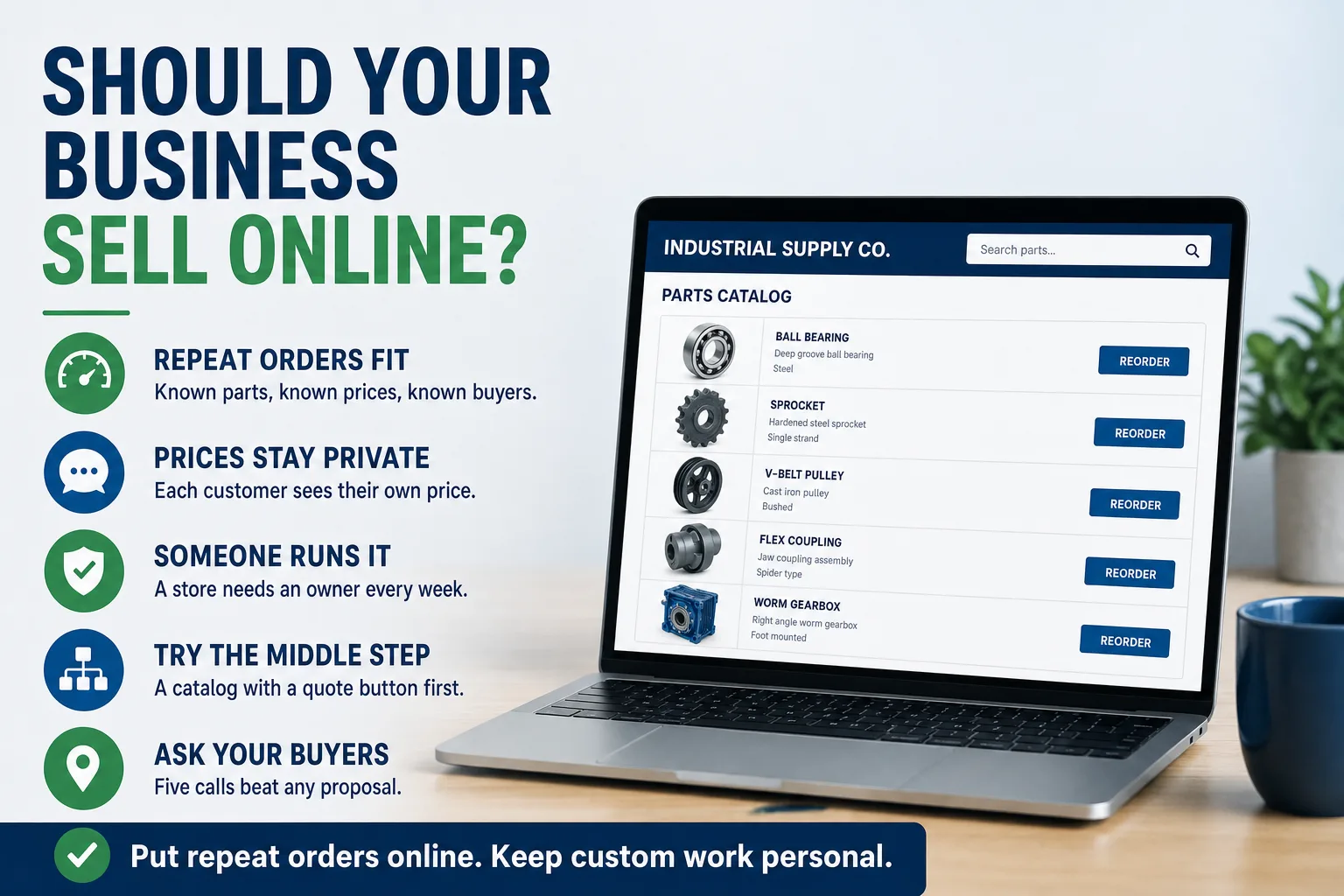
An online catalog with clear specs and a quote button lets buyers find you and your parts on Google without you publishing a single price. A simple reorder form lets existing customers pick from their usual items and send the order to your inside sales team. An order status page answers the question your reps hear most. Each of these can be built in a way that grows into full ordering later, if the demand shows up.
Not selling online at all is also a valid choice. One of our clients, Gun Boss, is a retail shop whose site was built so that every button points to the physical store, not a checkout. That was the right call for that business. Plenty of manufacturers are in the same position: the website's job is to start the conversation, and the sale happens with a person.
If you do decide to go further, write down what you want before you collect quotes. A two page website brief keeps three proposals from describing three different projects.
A test you can run this week
Ask your inside sales team what share of their week goes to repeat orders of the same items. Ask how many customers have asked, in writing, to order online. Count how many of your customers have contract pricing.
Then call five of your best customers and ask one question. "If you could reorder from us online, would you, and what would you need to see?" Their answers will tell you more than any proposal.
If repeat orders are a big share of the work, customers are asking, and you can name the person who will run it, online ordering is probably worth pricing out. If not, start with the catalog and a better quote request, and revisit in a year. If you want a second opinion on which side you are on, we are happy to talk it through.