How to Write a Website Brief That Gets You Quotes You Can Compare
Three vendors, three quotes, and no way to tell them apart. A two page brief fixes that. What to put in it, what to leave out, and how to read the replies.
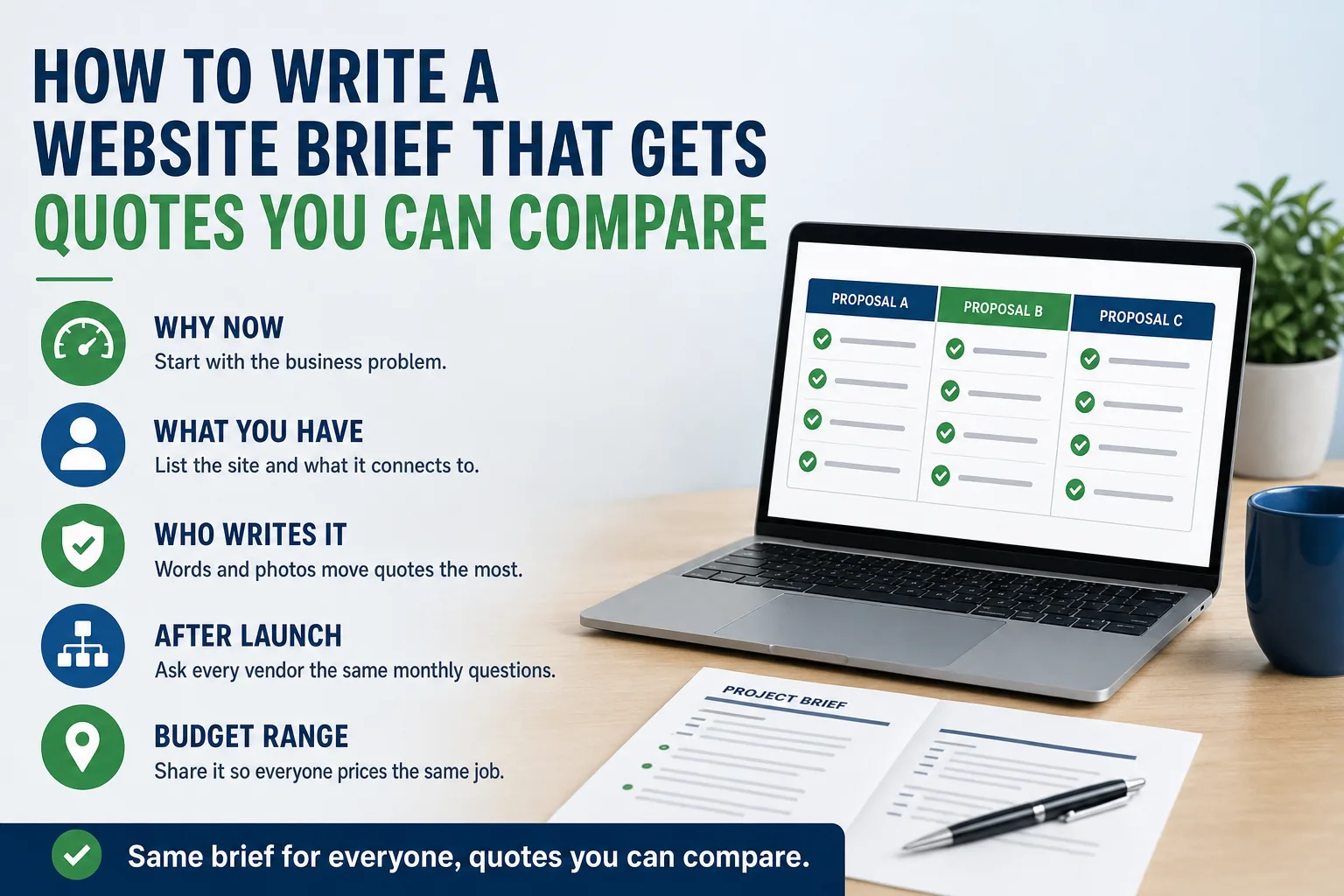
Three website quotes are on the desk. One is a single page. One runs eleven pages. The third is a number in an email and an offer to talk. The highest is several times the lowest, and nobody in the room can say why.
That is usually not because one vendor is honest and the others are not. Each of them guessed at a different project. You asked three builders to price a building without drawings.
A website brief is the drawing. It is two or three pages, written by you, that describe the business problem, the work, and what happens after launch. Send the same brief to everyone and the quotes start to line up. Where they still differ, the difference finally means something.
Why the quotes come back impossible to compare
Without a brief, every vendor fills the gaps with their own assumptions. One assumes your team will write the words. Another includes a writer. One prices ten pages, another prices forty. One includes the first year of care and hosting, and another stops on launch day.
None of that is a trick. But the cheapest quote is often the one that assumed the least work. You find out about the rest later, one change order at a time.
The good news is that a brief does not need to be technical. Vendors do not need you to pick software. They need you to describe the business, the buyer, and the job.
Start with the business problem, not the website
Open the brief with why now. "Quote requests have dropped since spring." "We opened a second location and the site still lists one." "Our largest customer could not find our certifications." A vendor who knows the reason can propose the right size of project. A vendor who only hears "we need a new website" will send their standard package.
Then say who the site is for. A purchasing manager comparing three suppliers wants different things than a facilities director with a leaking roof. Describe your best customer and what they need to see before they pick up the phone.
Finish this part with what success looks like, in your own units. More quote requests from the right kind of buyer. Fewer calls asking the same three questions. Applicants for the jobs you cannot fill. Pick one or two goals. A brief with ten goals has none.
Describe what you have today
List your current web address, who built the site, who looks after it now, and roughly how many pages it has. Say what works and what embarrasses you. If you do not know some of it, write that down too. A good vendor will help you find out, and it is worth checking who actually controls your website before anyone starts.
Then list everything the site is connected to. Which inbox the quote form sends to. Online payments. A customer login. A product list that comes from your inventory system. Online scheduling. These connections are where quotes differ the most, because they are where the real work hides.
Last, name what must not break. If certain pages bring in calls from Google today, say which ones. A new site that throws away the pages people already find can cost you months of leads.
Spell out the work so everyone prices the same job
Give a rough page count by type: services, industries you serve, locations, about, team, careers. Exact numbers are not needed. A range is fine.
Then answer the question that moves quotes more than any other: who writes the words, and who supplies the photos? If you expect the vendor to write everything, say so. If your team will write it, give a date and be honest about whether that date is real. Unwritten pages are the most common reason a launch slips.
Describe each feature in plain words, as an outcome. "A form that sends quote requests to sales and copies the owner." "A careers page where applicants can attach a resume." "A catalog of a few hundred parts that our office can update." Then split the list into must-haves and nice-to-haves, and ask vendors to price the nice-to-haves separately. That split teaches you more than anything else in the replies.
Ask about life after launch in the same words
Launch day is the beginning of the cost, not the end. Ask every vendor to answer the same four questions in writing. What does this cost each month after launch, and what does that include? Who makes small changes, and how fast? Whose accounts will hold the web address, the site files, and the Google listings? What happens if we part ways?
Ask for the next three years, itemized, not just the first. Monthly fees are where vendors differ most, and they are the hardest part to compare after the fact. If you want a yardstick for the monthly part, here is what a care plan should actually do.
What to leave out, and one thing to put in
Leave out the technology, unless you have a real reason to require something. Leave out a design wish list like "modern and clean." Every vendor will promise that. Show two or three sites you like instead, and say what you like about each.
Put in a budget range. It feels like giving away your position. It does the opposite. Without a range, one vendor proposes a careful small site and another proposes everything, and you are back to comparing two different projects. With a range, every vendor tells you what fits inside it, and what they would cut.
Add a decision date, too. Vendors take a brief with a real date more seriously, and it keeps your own team moving.
Reading the quotes that come back
Lay each quote next to the brief and mark what it included, left out, or changed. The gaps are now easy to see, because everyone answered the same questions.
Pay attention to the vendor who pushes back on part of your brief and explains why. That is usually someone thinking about your business rather than their template. Be wary of a quote that ignores the brief and sends the standard package anyway, or one that will not put monthly costs in writing.
Then do the follow-up interviews. These questions to ask before you hire anyone pick up where the brief leaves off.
This week, open a blank document and write one page under these headings: why now, who it is for, what we have, the work, after launch, budget and date. That first page is most of the brief. If you would like us to quote against it too, send it over. We would much rather price a brief than a guess.