Selling Your Business? What a Buyer Will Ask About Your Website
Buyers ask who controls your web address, email, and Google listing. How to have clean answers ready before the sale, so loose ends do not cost you money.
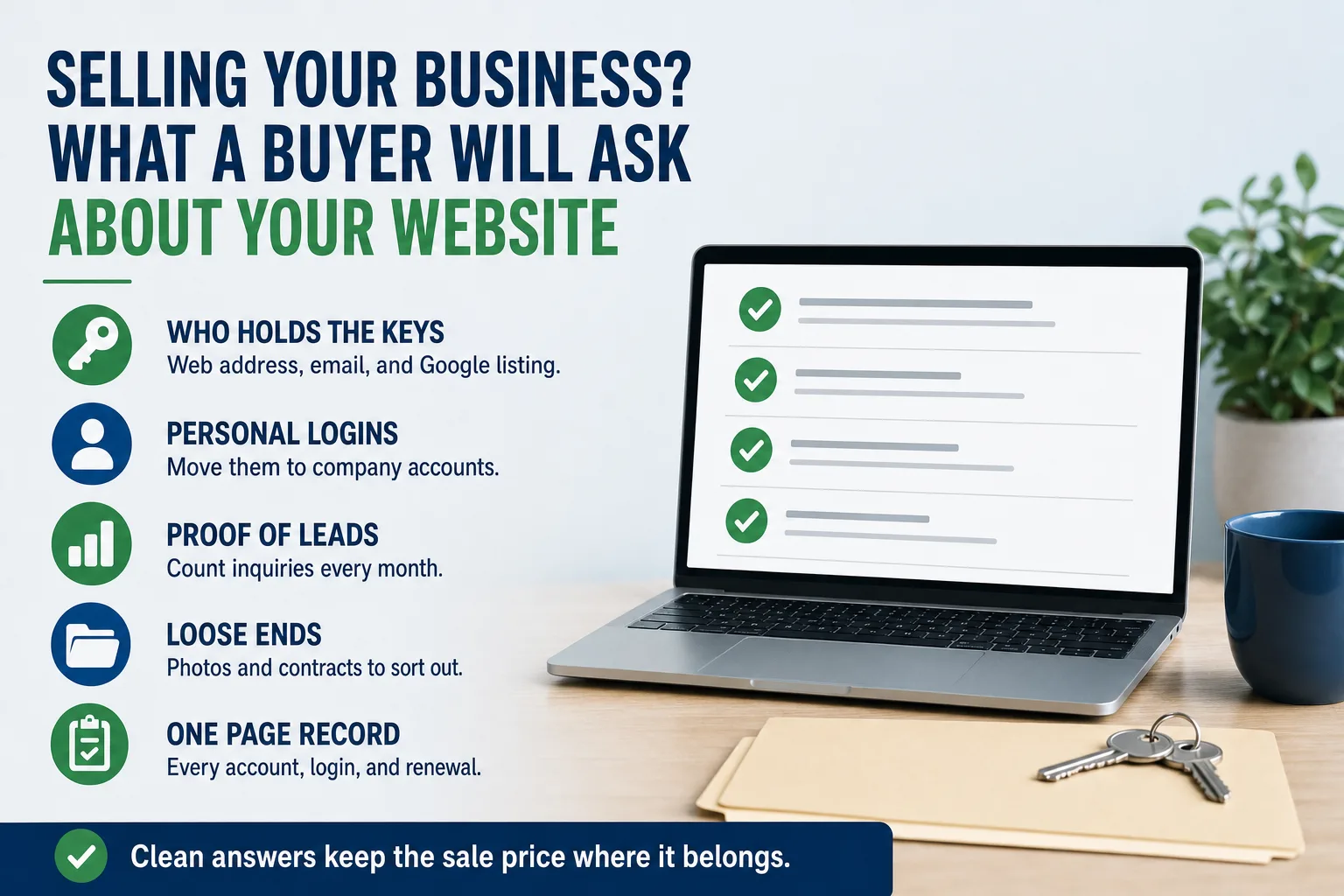
The broker sends over the list. Tax returns, equipment, customer contracts, leases. And somewhere in the middle, one line nobody expected to slow things down: list every website, web address, and online account the company uses, and who controls each one.
The owner starts writing and stops. The web address was registered by a nephew years ago. The Google listing is tied to a personal Gmail account. The website login belongs to a designer who retired. Nothing is broken. It just does not belong to the company on paper.
None of this kills a deal. But every loose end a buyer finds becomes a question, and questions late in a sale tend to turn into price talks, delays, or money held back until the problem is fixed.
Why a buyer cares about something you rarely think about
A buyer is not paying for your logo or your homepage. They are paying for the phone ringing next year. For most companies that sell to other businesses, the web address, the company email, the Google listing, and the reviews are a big part of how that phone keeps ringing.
If those things cannot move cleanly to the new owner, the buyer is taking on a risk. Their lawyer and accountant will look for exactly that kind of risk. It is their job.
So the question behind every website question is simple. When you hand over the keys, will customers still find the business, reach it, and trust it? Your job is to make the answer an easy yes.
The questions that usually come up
Every buyer is different, but the same handful of questions shows up again and again. Who controls the web address, and when does it renew? Where does the company email live, and who can reset its password?
Who owns the Google listing, and can ownership be handed over without losing the reviews? Where do website inquiries go, and roughly how many came in last year? What does the website cost to run, and which contracts or subscriptions keep it going?
And one that surprises people: has anyone ever made a legal claim about the website? That includes accessibility demand letters and letters about photos used without permission. A buyer would rather hear about an old, settled letter from you than find it on their own.
If you can answer all of these from memory, you are ahead of most sellers. If you cannot, you have found your homework.
The accounts tied to you personally
This is where most sellers get stuck. Over the years, accounts get opened with whatever was handy. A personal email address as the login. A personal credit card on the renewal. A personal cell phone receiving the security codes.
It works fine while you run the company. After the sale, you leave, and those things leave with you. The new owner cannot reset a password that sends a code to your phone. The renewal fails when you cancel your card. The web address can lapse, and the company email can go down with it.
The fix is dull and worth doing early. Create a company email address that belongs to no single person, something like an admin or office mailbox. Move every login, recovery address, and billing card for the website and online accounts over to company ones. Add a second trusted person as an owner wherever the account allows it.
For the Google listing, add the right people as owners now, so the final handover is one step. Reviews belong to the listing, not to you, so the reviews you worked to collect stay with the business when ownership moves.
Can you show where your customers come from?
Saying the website brings in work is a story. Showing it is evidence. Buyers pay for evidence.
You do not need fancy reports. A simple monthly count of website inquiries and calls that mention the website, kept in a spreadsheet, is enough to show a pattern. Even better if you can note which ones became paying jobs.
If you are a year or more away from selling, start that count this month. Twelve months of plain numbers you collected yourself will carry more weight than any traffic chart. If you are closer than that, pull what you can from your inbox and call records, and be honest about the gaps.
Loose ends that turn into price talks
Small problems behave differently during a sale. On a normal Tuesday, they are a nuisance. In a negotiation, each one is a reason to lower the number or to hold money back until it is fixed.
Photos are a common one. If a photographer took your project photos, check what your agreement actually allows. Stock photos bought under someone else's account can raise the same question.
Vendor contracts are another. A website or marketing contract that renews on its own, or that is with a person who no longer answers, needs sorting out before a buyer asks. So does any site that lives inside a platform account opened by a former employee.
None of these is hard to fix with time. All of them are hard to fix in the last week before closing.
A one-page record to start this month
The most useful thing you can hand a buyer is a single page that lists every account the business depends on online. For each one, write what it does, which company login controls it, when it renews, what it costs, and who to call about it.
Start with the web address, the company email, the website itself, the Google listing, and any social pages. Then add the smaller things, such as the service that delivers your contact form messages and any paid listings. Our article on who actually owns your website walks through how to check each one yourself.
Then test it. Pick someone in the office who is not you and ask them to log into each account using only that page. Anything they cannot reach is something a buyer cannot reach either.
This is worth doing even if a sale is years away. The same page protects you if a key employee leaves or your web person disappears. It is also the setup we use by default for the sites we manage: the company holds its own accounts, and we work inside them. If you would like a second set of eyes on your list, send us a note.